
Nerve Health · 660nm Ankle Therapy
Neurologist: For 18 Years I Told Patients Nerve Pain Couldn't Be Reversed. Then My Own Mother Stopped Sleeping.
If you — or someone you love — has burning, tingling or numb feet at night, please read this before buying another cream, patch or supplement.
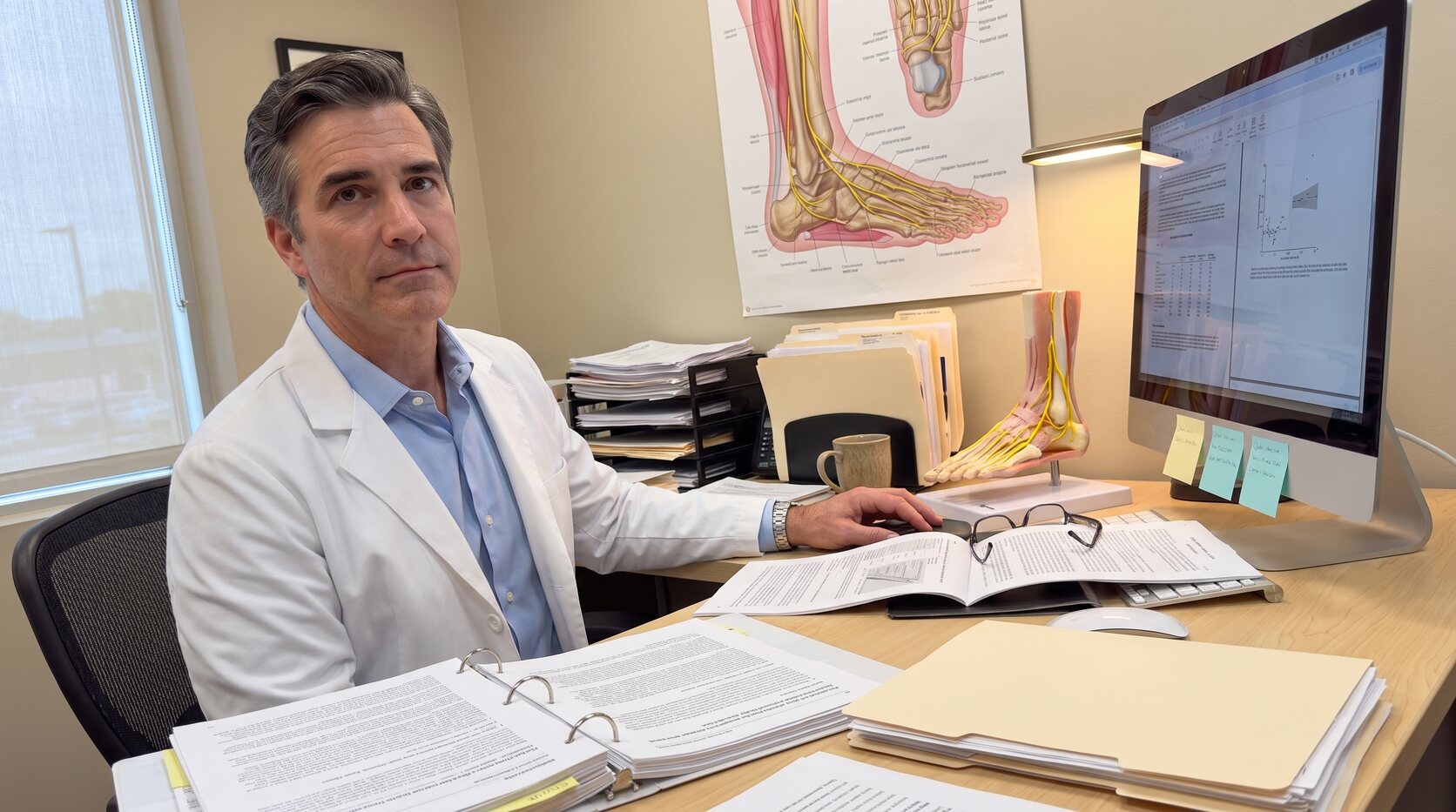
Hi. My name is Dr. Alan Reese. I'm a board-certified neurologist in Charleston, South Carolina, and I have spent eighteen years treating peripheral neuropathy.
In that time I have seen more than two thousand patients with the same set of complaints:
- Burning in the feet that gets worse at night
- Tingling that somehow still hurts
- Numbness that doesn't feel like nothing
- Feet that are cold to the touch and on fire from the inside
I know what those words mean because I have heard them thousands of times. I thought I understood them.
I did not understand them until my mother started saying them.
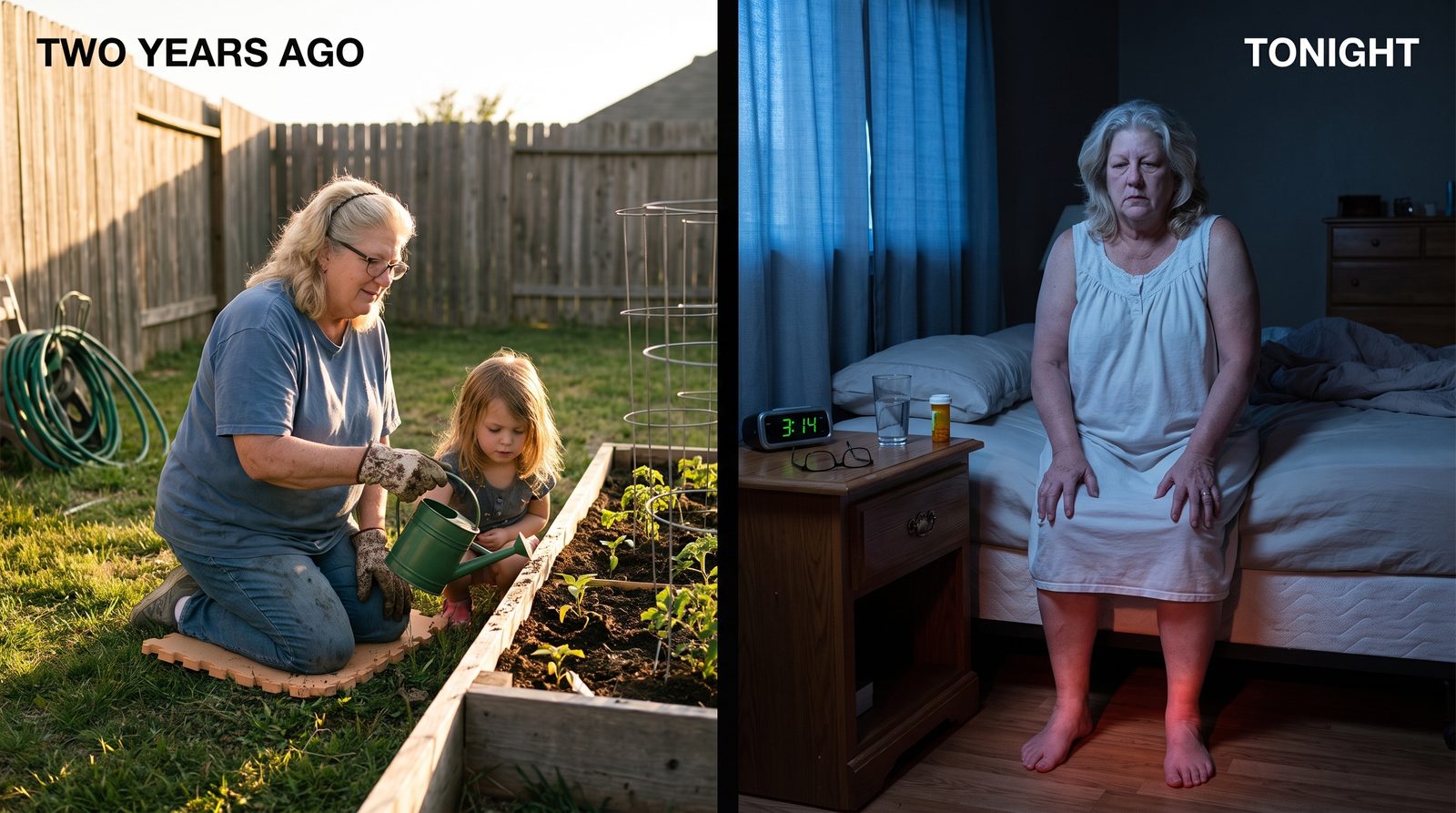
Her name is Ellen. She is seventy-six. She is my mother.
It began the way it usually does — a tingling in both feet that she mentioned once, in passing, and did not mention again for months. By the time she brought it up a second time, it had become burning. By the following spring she was going to bed at ten and getting up at three.
There is a photograph on my refrigerator of Ellen lying flat on her living room floor, on her stomach, doing a puzzle with Nora, my brother's youngest. Nora is four. My mother has always been the one who gets down on the floor — she did it when I was small, and she was still doing it at seventy-five.
That spring, she stopped getting down on the floor. She never announced it. She simply started saying "come sit up here with Grandma instead." And Nora, who is four and adjusts to everything, stopped asking.
That is the part that does not go in a chart. My mother was quietly making herself smaller, one ordinary thing at a time. The only person who noticed was me — and I was the one with no answer.
The workup came back clean. Her blood sugar was normal — she is not diabetic. No B12 deficiency, no thyroid problem, no autoimmune marker, no chemotherapy history. Nerve conduction confirmed what I already knew from watching her walk to the kitchen.
Idiopathic peripheral neuropathy. Idiopathic is the word we use when we cannot name the cause. It is an honest word. It is also a word that ends the conversation.
And then I heard myself tell my own mother the sentence I had said to two thousand strangers:
We can manage the symptoms. We can't reverse the nerve. — What I had told two thousand patients
She nodded. She has always been kind about my work.
But I have to tell you something honestly, because this whole article depends on it: when I said that sentence to her, for the first time in eighteen years, it did not sound like medicine to me. It sounded like giving up.
So I went back to the beginning. Not to the treatment. To the anatomy.
Free shipping · 60-day money-back
The root cause almost nobody explains to you
Here is what I should have explained to every one of those two thousand patients, and did not, because a fifteen-minute appointment does not allow for it.
When somebody tells you that you have nerve damage, the same picture appears in everybody's head: a wire with a break in it somewhere.
That picture is why the diagnosis sounds like a sentence being passed on you. A wire is a dead object — nothing feeds it, nothing repairs it. You do not nurse a bad wire back to health; you cut it out and replace it, and there is nothing in a human foot to replace.
But there is no wire in your foot. A nerve is living tissue, with its own blood supply and its own appetite. It works for exactly as long as it is fed.
And that changes what your symptom means. A bad wire goes quiet — stopping is the only failure a dead object has available to it. Your foot did not go quiet. Your foot is loud. It reports fire at three in the morning when there is no fire anywhere in the room.
A dead object cannot invent a signal. Only something alive, and under stress, can. So the burning is not a wire that snapped. It is living tissue that is not getting what it needs — a completely different problem, with a completely different list of options.
Nerves are fed by their own private blood supply. Anatomists call it the vasa nervorum — literally, "the vessels of the nerves." These are micro-vessels thinner than a human hair, and they exist for one purpose: to carry oxygen and glucose to nerve tissue that cannot survive without a steady supply.
With age, those micro-vessels narrow. Gradually. Silently. Nothing ruptures. Nothing tears. There is no break to find — which is precisely why imaging so often comes back saying nothing is wrong. The channel simply gets narrower, year after year. Not broken. Underfed.
And the nerve at the end of that supply line begins to receive less than it needs.
Here is the part that matters, and the part that will explain your own symptoms to you:
A starving nerve does not go quiet. It misfires.
It fires when nothing has touched it. It reports burning when there is no heat anywhere near it. It sends a pain signal because sending a distress signal is precisely what living tissue does when its energy supply runs low — which is something a wire, having no needs of its own, never has any occasion to do.
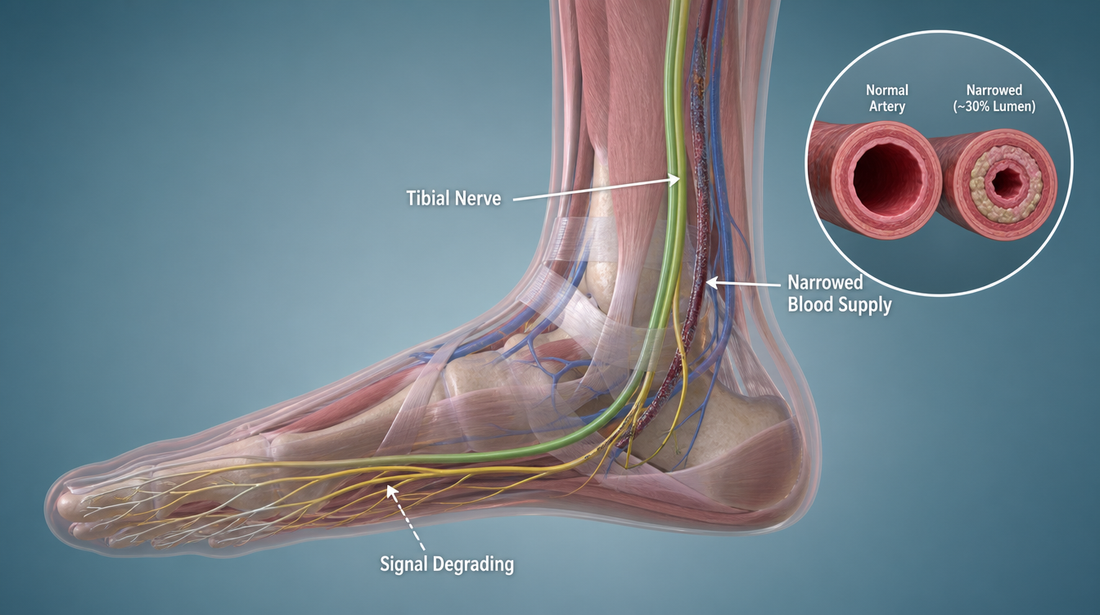
That, finally, explains the symptom that confuses everyone — including a lot of physicians: why can a foot be burning and numb at the same time?
Because there are two different fibre populations in the same nerve, and they fail at different speeds. The small fibres — the ones carrying heat and pain signals — degrade first, and they misfire loudly on their way down. The large fibres — the ones carrying touch and position — fail later, and they go quiet. So you get a loud wrong signal and a missing correct signal from the same foot, at the same moment.
That is not you exaggerating. That is not you describing it badly to your doctor. That is two fibre types running on two different levels of empty. A wire does not have populations. Only living tissue can fail in two directions at once.
I had spent my whole career looking for a break. There was never a break. There was a shortage. — Dr. Alan Reese, MD
It took me eighteen years and my own mother to say it this plainly. You cannot feed a break. A shortage is something you can do something about.
Free shipping · 60-day money-back
Why everything she tried had already failed — before she tried it
Ellen tried what my patients try. I know, because I was the one who prescribed most of it.
Please understand: none of these are frauds. Every one of them does exactly what it was designed to do. The problem is not that they are dishonest. The problem is where each of them stops.
What each treatment actually does — and where it stops
- Gabapentin / pregabalin — dampens the pain signal in the central nervous system. Stops at the brain. It never travels to the ankle where the signal is generated.
- Capsaicin cream — depletes substance P in the outermost skin nerve endings. Stops in the skin. It is a topical, and it stays topical.
- Lidocaine patch — blocks sodium channels in surface nerve endings. Stops at skin level. A local anaesthetic, not a repair.
- Compression socks — improve venous return, blood flowing back to the heart. Wrong direction. It does not increase the supply flowing in.
- B12 supplements — correct a deficiency. Only helps if you are deficient. Ellen was not.
- Heating pad under the foot — warms the skin of the sole. Disperses at the surface — and it is the sole, not the ankle.
- $39 red-light pad online — emits light at an unspecified wavelength. Usually not 660nm, and often not enough of it to matter.
Read that second half of each line again. Every single treatment stops somewhere above, beside, or entirely away from the tissue that is starving.
So where is the actual target?
This is where I stopped being a son and went back to being a clinician. I pulled the imaging literature on the posterior tibial nerve — the main nerve trunk running behind the inner ankle bone, the one that branches out to supply the sole of the foot.
It does not sit in the skin. It sits in the soft tissue layer beneath it — behind the ankle bone, inside the tissue that wraps the joint.
Now hold that next to the list you just read.
A cream works in the skin. A patch works in the skin. An inexpensive red-light pad puts its light into the skin. The nerve is not in the skin.
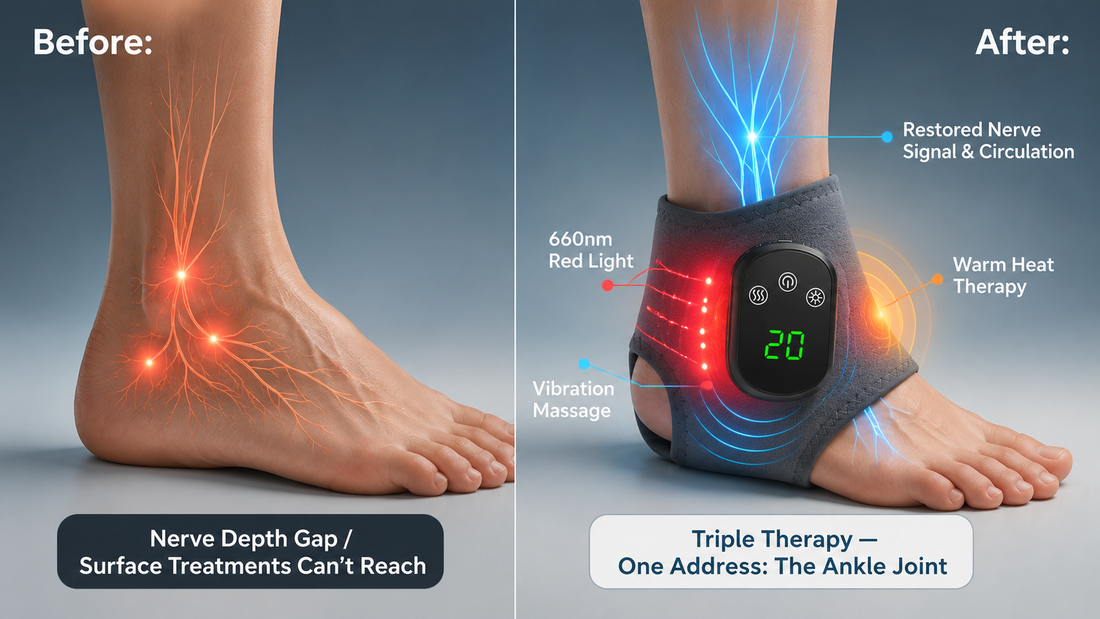
That distance — between the layer a treatment works in and the layer where the breakdown actually is — is the whole problem. I call it the Nerve Depth Gap. It is not a marketing phrase. It is an anatomical fact, and you can look it up.
And one more thing worth knowing: that nerve does not sit at the same depth in everyone. Imaging shows it varies considerably from one person to the next. So a device built to warm the surface is not a "weaker" version of one that works into the tissue. It is working in a different layer — and turning it up does not move it into the right one.
Free shipping · 60-day money-back
What would actually have to happen
Once I framed it as a supply problem instead of a damage problem, the requirements wrote themselves. Three things have to be true at the same time:
- Reach the right layer. Whatever we use has to work in the soft tissue where the nerve trunk lies, not stop at the skin.
- Reopen the supply line. The narrowed micro-vessels have to widen so blood can get in.
- Deliver it at the right address — the ankle, not the sole. The tibial nerve trunk passes behind the inner ankle bone. That is the junction. Treating the sole is treating the branches downstream of the shortage.
Number 2 and 3 I knew how to do. Heat widens vessels; that is first-year physiology. Mechanical stimulation moves blood; that is why we massage.
Number 1 was the one I had been dismissing for fifteen years.
The technology I had been ignoring since residency
It was two in the morning. Three miles away, Ellen was sitting in her own kitchen with the lights off — she has done that for two years, and she has never once known that I was awake as well. And I was at my desk reading about photobiomodulation.
Red light therapy. The thing I had filed under "insufficient evidence" in 2011 and never re-opened.
Here is what I had missed, and here is the honest history of it.
This did not start in a wellness shop. It started at NASA. In the 1990s, NASA funded LED research for growing plants on long-duration space missions. What they observed was that the same wavelengths that drove plant cell metabolism also accelerated wound healing and tissue repair in human cells — which mattered enormously, because wounds heal poorly in microgravity. That work moved from plant chambers into military and clinical trials on tissue repair and nerve injury.
Then it did what most good technology does. It got stuck in expensive rooms.
For the next two decades, if you wanted clinical photobiomodulation, you needed access to a device that cost between eight and fifteen thousand dollars. Sports medicine practices had them. Professional teams had them. Olympic training centres had them. High-end rehabilitation clinics had them, and charged $80 to $120 per session for time in front of one.
My hospital did not have one. My mother certainly did not.
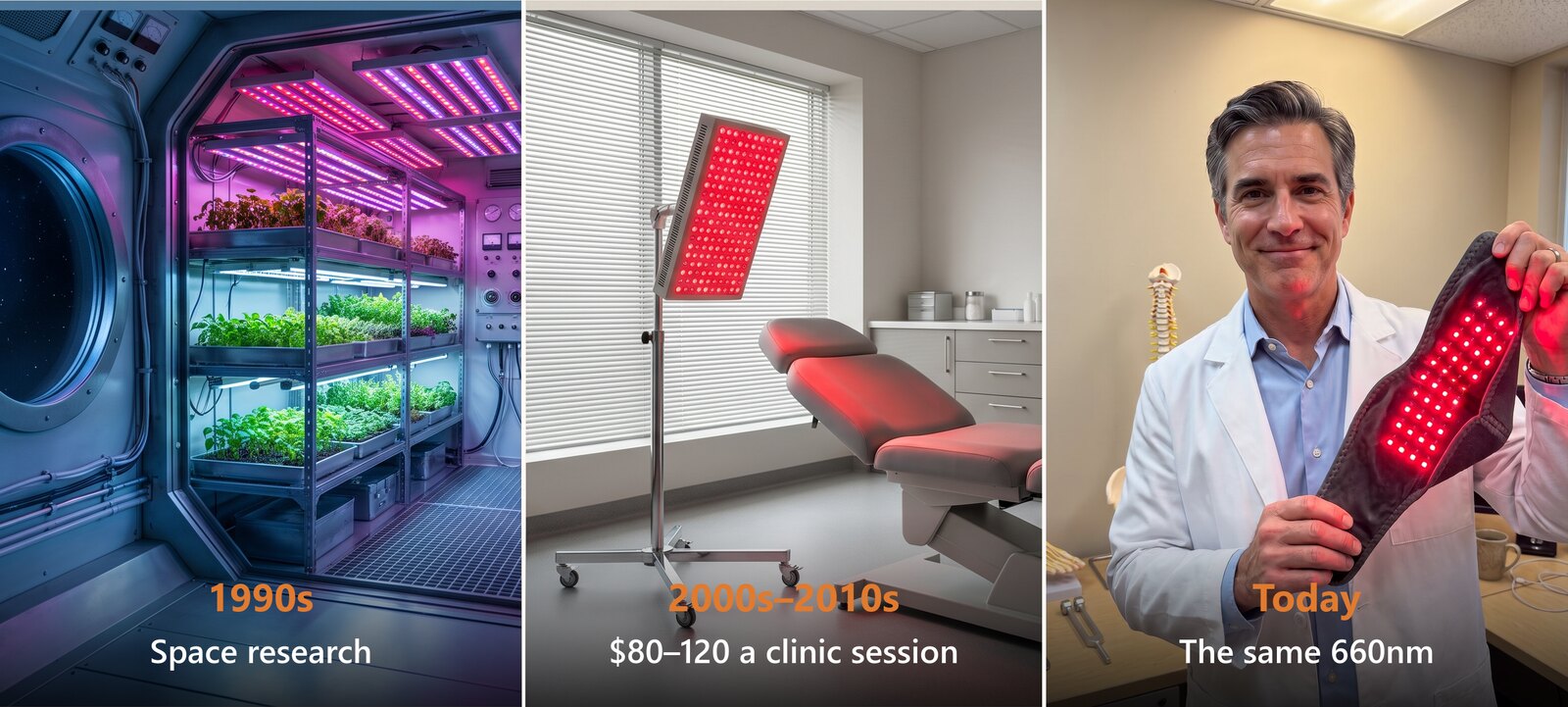
And here is the specific thing I had been getting wrong for fifteen years: I had been treating "red light" as one thing. It is not. The wavelength is the entire mechanism.
660 nanometres is a specific figure, and it matters for a specific reason. At that wavelength, photons pass through skin and soft tissue rather than dispersing at the surface the way heat does — deep enough to arrive at the layer where the nerve trunk and its vasa nervorum actually sit. Once there, they are absorbed by cytochrome c oxidase, an enzyme inside the mitochondria of the cell. Cytochrome c oxidase is the final step of the chain that produces ATP — the fuel every cell in your body runs on.
Read that again with the starving nerve in mind.
A nerve whose blood supply narrowed is, in plain terms, a cell running out of fuel. 660nm does not mask its signal. It does not sedate the brain that receives the signal. It delivers energy to the machinery that ran out of it — at the depth where the machinery actually is.
That is not a different strength of the same idea as a heating pad. It is a different idea.
There is now randomised trial evidence in this exact patient population: a controlled study of two hundred patients with diabetic peripheral neuropathy found that ten sessions of photobiomodulation significantly reduced neuropathic symptoms and improved protective sensation in the foot compared with controls.
I had a mechanism, a depth, and a wavelength. What I did not have was a device that put all of it at the ankle, in a house, for a price someone living on a pension could pay.
Free shipping · 60-day money-back
So I did something I had never done in eighteen years
I called a manufacturer.
I reached out to TheraPrime, a US therapeutic device company, and I told them what I have just told you: the wavelength has to be 660nm specifically, the heat has to be measured in degrees rather than "low / medium / high," it has to shut itself off automatically, and — this is the part every other product gets wrong — it has to sit at the ankle joint, not under the foot.
That last requirement is not a preference. The posterior tibial nerve passes through a narrow channel behind the inner ankle bone, and in the great majority of people it divides into its branches inside that channel. Which means the ankle is not merely a good place to work. It is the last point where you can reach the whole nerve, before it splits into the branches that run out to the sole of the foot.
Treat the ankle and you are upstream of everything. Treat the sole and you are downstream of the shortage, working on branches that are already starved.
The TheraPrime Triple-Therapy Ankle Recovery System
It is a 360° wrap that closes around the entire ankle joint — full contact from every side, because the nerve trunk, its branches and the micro-vessels that feed them do not sit on one surface. They run around the joint. A device that touches one face of the ankle misses most of the target anatomy.
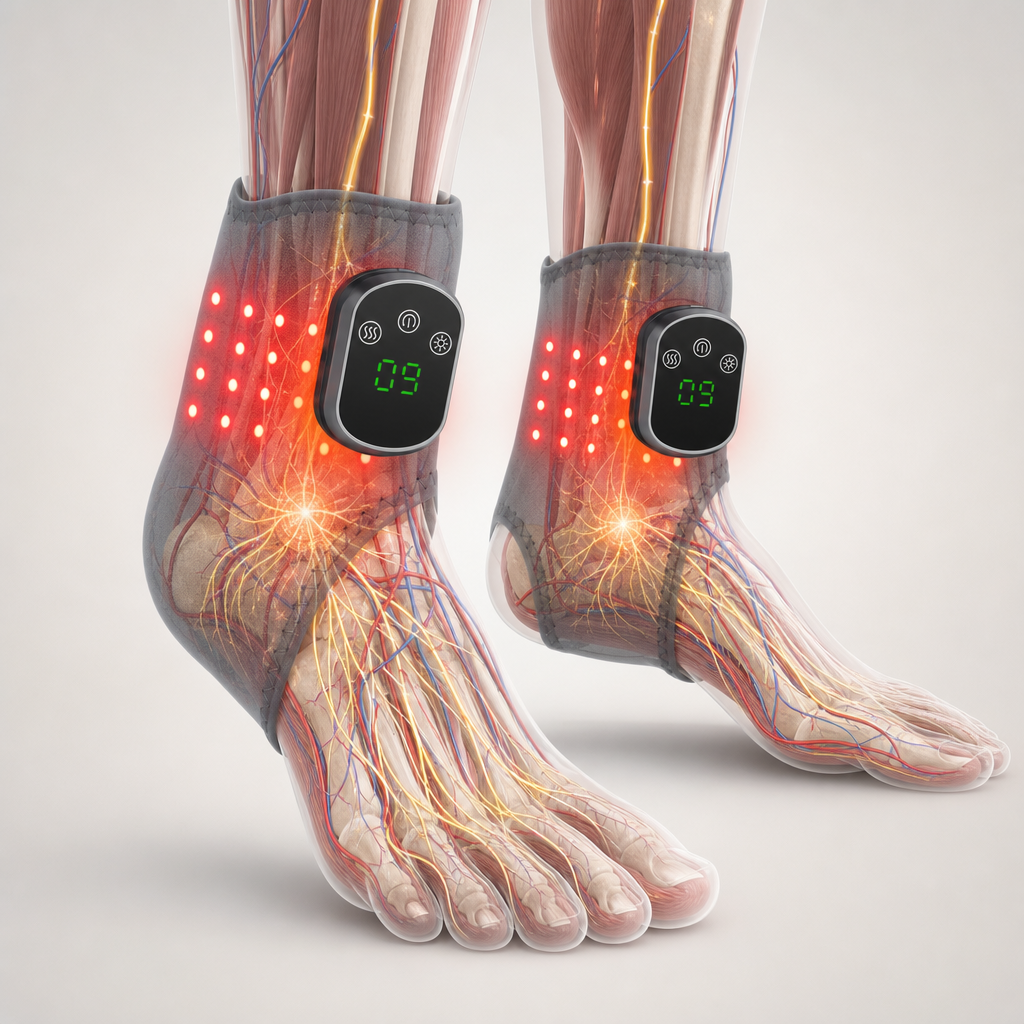
Three therapies run at the same time, at the same address. Each one answers a different requirement on that list I wrote at 2 AM.
660nm Red Light — reaches the layer
40 three-core LED beads emitting at 660nm specifically. The photons travel through skin and soft tissue to the layer where the nerve trunk sits, and are absorbed by cytochrome c oxidase in the mitochondria of the nerve cells — increasing ATP production in cells that had been running on a reduced supply. This is the requirement nothing else on Ellen's list even attempted.
Targeted Heat — reopens the supply line
Five precise levels: 40°C, 45°C, 50°C, 55°C, 60°C. Degrees, not adjectives. Applied directly at the ankle, heat causes the narrowed vessels feeding the nerve to widen — the supply line that has been closing down for years begins to open. And the intelligent auto-shutoff is not a convenience feature. Neuropathy reduces your ability to feel heat; a patient who cannot reliably sense temperature can burn skin with an ordinary heating pad and not know it until the next morning. As a neurologist, this was non-negotiable for me.
Vibration — keeps the blood moving through it
Three modes, delivered through the joint. Heat opens the vessel; rhythmic mechanical stimulation keeps fresh blood actively moving through it, carrying oxygen and glucose into tissue that has been short of both.
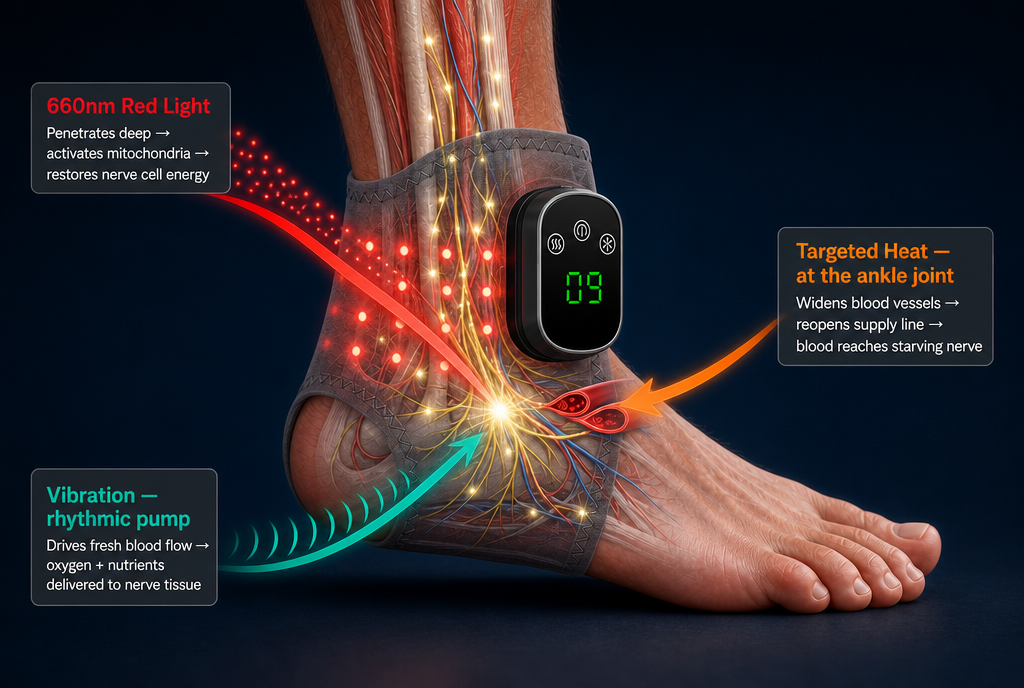
Twenty minutes. Once a day. The same session window used in clinical protocols.
Reopen the route. Keep it moving. And feed the cell directly.
That third one is where almost every other device stops short. When tissue has been underfed for years, restoring its supply is necessary and not sufficient — with an undernourished patient you restock the kitchen and you feed them directly, because a body running low that long cannot wait for the ordinary route to catch up.
And here is what the wire picture would never have let you see: every one of your nerve cells has a power plant of its own. That is what the mitochondria are. A wire has no power source — it only carries what someone sends down it. A living cell generates its own, and a cell short on supply for years is a power plant running at a fraction of what it was built for.
Heat and vibration work on the route. 660nm works on the power plant. Take it away and you have repaired the road and left the engine cold.
What's in the box
- 660nm red light, targeted heat and vibration in one 360° ankle wrap
- 40 three-core LED beads at 660nm
- Five temperature levels, 40°C to 60°C, with intelligent auto-shutoff
- Three vibration modes
- USB-C rechargeable — cordless while you use it
- CE, FCC and RoHS certified
- Twenty-minute daily sessions — the same window used in clinical protocols
Free shipping · 60-day money-back
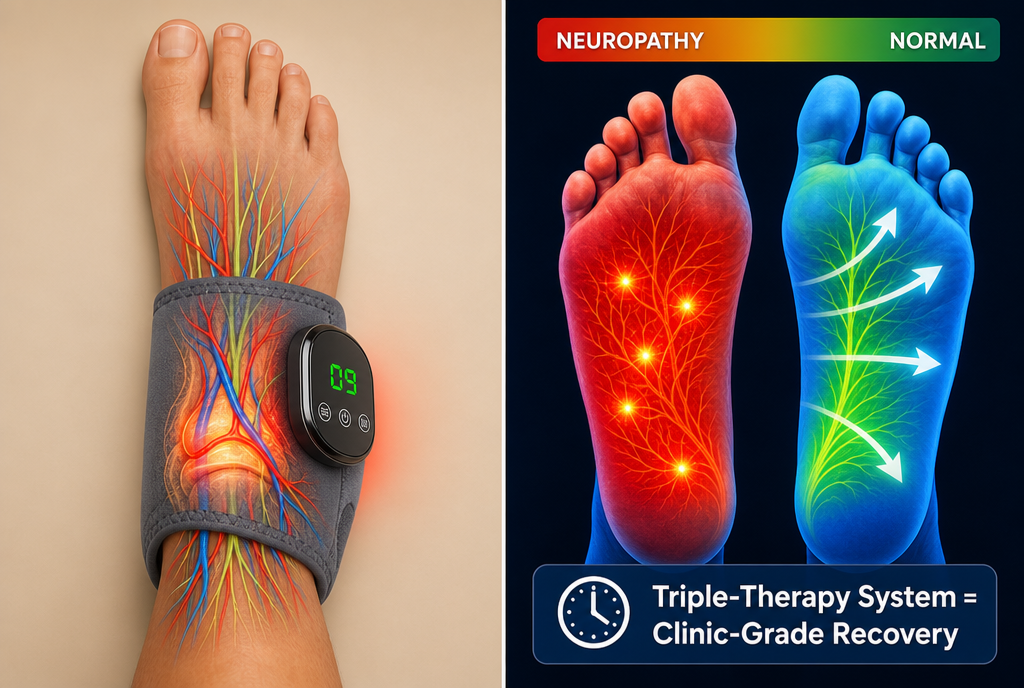
What changed — and what I measured
I want to be careful here, because I am a physician writing about my own mother, and that is the least objective position a person can occupy.
So I will tell you exactly what happened, and nothing more than that.
Week one. She still woke at three. But she told me the burning "stopped climbing" — it reached a level and stayed there instead of escalating. She did not get up.
Week two. The night episodes were shorter. The morning numbness cleared faster — she noticed it going away while making coffee instead of an hour later.
Week five. She slept through until five in the morning.
She did not announce it. She mentioned it on the phone, the way you would mention the weather. I did not say anything either, because I did not trust my voice.
I will not tell you this is a cure. It is not, and any product that tells you otherwise is lying to you. Nerve tissue recovers slowly when it recovers at all, results differ between people, and idiopathic neuropathy is not one disease.
For the first time in eighteen years, I was treating the supply instead of the signal. — Dr. Alan Reese, MD
That is not a small change in degree. That is a change in what we were aiming at.
Free shipping · 60-day money-back
Real people, real relief

Dorothy K., 68 · Richmond, VA
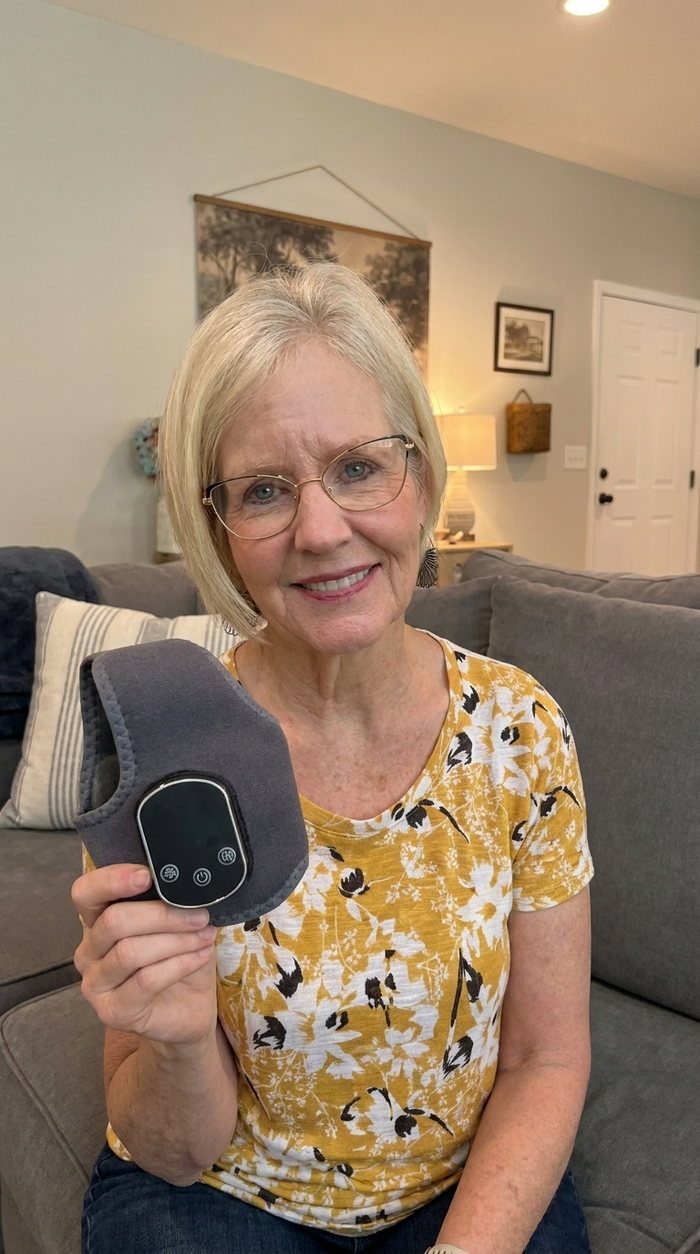
"I've had bilateral neuropathy for four years. I was skeptical of everything at this point. By week three, I slept through the night for the first time in two years. I ordered a second one for my sister in Dallas."

Linda R., 71 · Tampa, FL
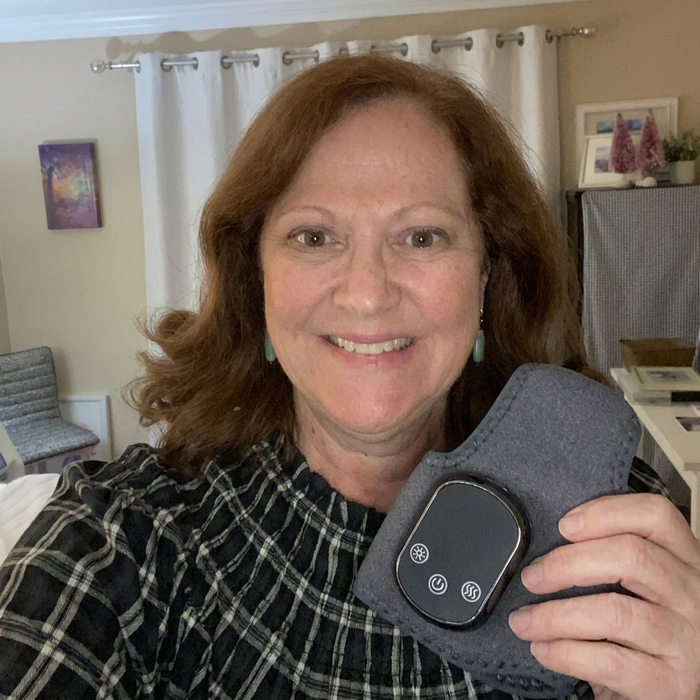
"Chemo ended three years ago but the neuropathy stayed. My oncologist said it was expected. Two weeks in with this device I slept through to 5 AM. I told my daughter and she cried. That's how long it had been."

Margaret S., 67 · Atlanta, GA
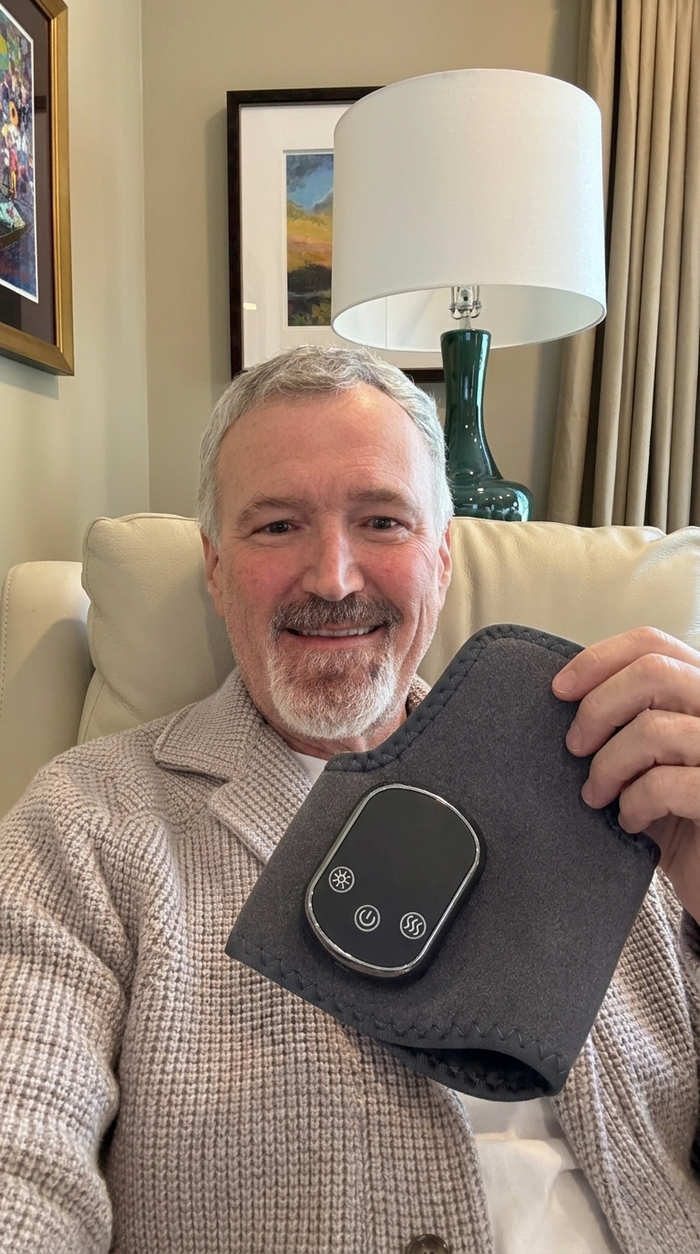
"Bilateral neuropathy. I'd tried everything already — gabapentin, B12, foot massagers. None of it reached far enough. Week three of using this, my husband noticed I stopped getting up at 3 AM to sit in the dark."
Free shipping · 60-day money-back
Before you compare it with anything else
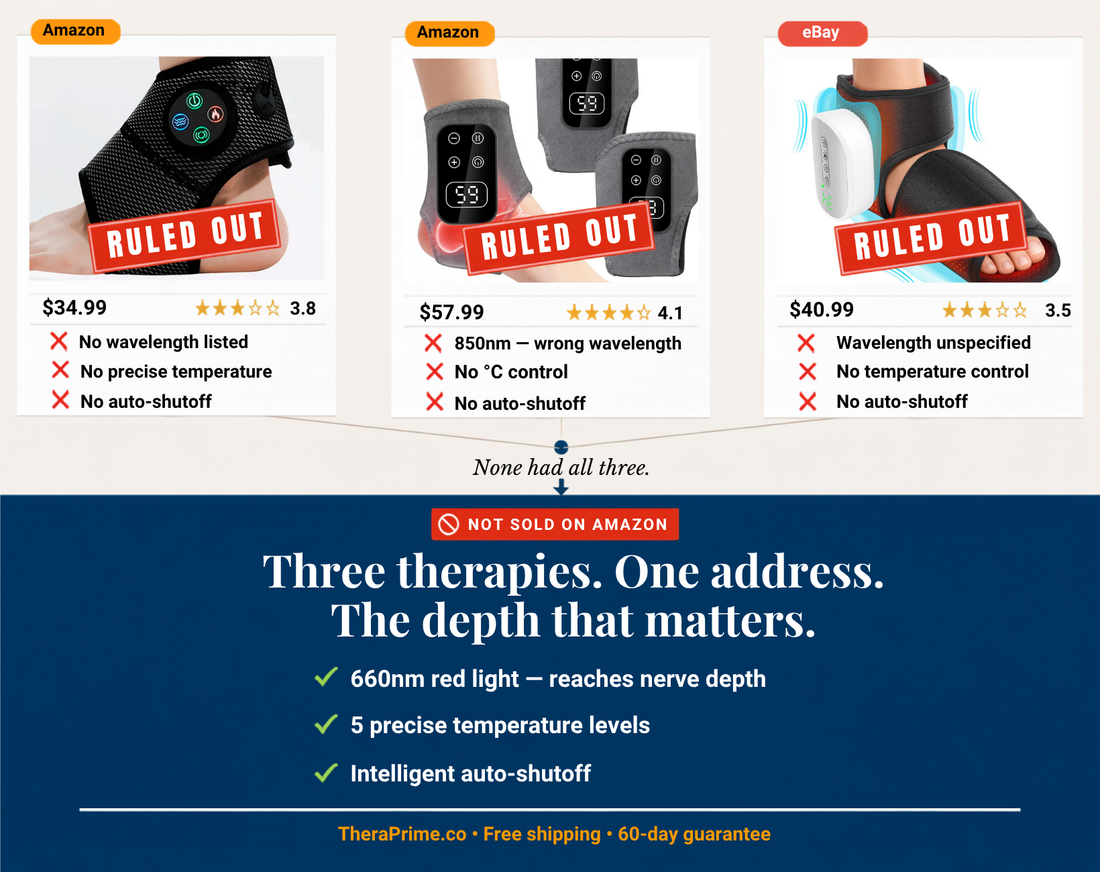
You will find ankle wraps online that look identical in a thumbnail. Some cost $30 to $60. As a physician, let me give you the three questions I would ask about any of them — including this one.
1. What is the wavelength — the number, not the label? "Red light therapy" is a category, not a specification. 850nm is a different wavelength with different tissue behaviour. "Infrared" without a figure usually means nobody wants to tell you. 660nm is where the research on nerve tissue and mitochondrial absorption sits. A wrap with heat and vibration but no 660nm is working on the route and nothing else — it never reaches the power plant, and for tissue that has been running low for years, that is the half that matters most.
2. Does the heat have degrees and an automatic shutoff? If it says "warm / hot," it has no thermostat. For a person with reduced sensation in the feet, that is a burn risk, not a comfort preference.
3. Does it sit at the ankle joint, or under the foot? After everything above, you already know why this is the question that decides the rest.
If a product description does not answer all three clearly, assume the answer is no.
What this costs — and what the same therapy costs everywhere else
Photobiomodulation at a physical therapy or sports medicine clinic runs $80 to $120 per session, when you can find a practice that offers it at all. A standard course is twelve sessions: $960 to $1,440, before follow-up visits, before parking, before the drive.
What this costs — and what it's worth
The TheraPrime Solo Recovery — one ankle — is $109.97, $70 off the regular price. That is about one clinic session. Used once a day for a year, it works out to less than $0.31 per therapy session.
It ships free. It is not sold on Amazon or eBay. If you see something that looks like it on a marketplace listing, it is not this device.
Free shipping · 60-day money-back
Why I recommend the pair, and not one
I want to be straightforward about this rather than let a checkout page make the argument for me.
Idiopathic peripheral neuropathy of this type is length-dependent. It affects the longest nerve fibres in the body first — which means it begins at the far end of both legs, at the same time, in the same pattern. That is exactly why the classic presentation is called a stocking distribution, and why almost every patient who walks into my clinic describes it in both feet, not one.
If one foot is currently worse than the other, that is usually a difference in timing, not a difference in whether the other foot is involved.
Treating one ankle and leaving the other is treating half of a symmetrical condition. That is the only reason I recommend the pair. Not because it is the larger order.
The Symmetry Pair — both ankles — is $149.97, which works out to $74.99 per ankle. That is still less than two clinic sessions of the same therapy. If you would rather start with one and see for yourself first, the Solo Recovery is $109.97 and the sixty days apply either way.
You have 60 days. The risk is mine, not yours.
I asked for one thing in particular when we put this together, and it was not a feature.
Ellen had already spent money on things that did not work. So had every patient I have ever handed a prescription to. By the time someone has been through gabapentin, creams, patches, socks and supplements, the honest obstacle is no longer skepticism about the science. It is the memory of having paid for hope before.
So: 60 days, full money-back guarantee, no questions asked.
Use it every day for two months. If your nights are no different, send it back and you get your money back. You do not need to explain yourself, and you do not need to convince anyone. Nerve tissue does not respond in a week — which is exactly why the trial window has to be longer than the point at which you would give up.
That is the entire point of a sixty-day window. It outlasts your doubt.
The device, by the numbers
CE · FCC · RoHS · Free shipping · 60-day money-back · Not sold on Amazon
Common questions, honestly answered
How is this different from a heating pad or a cream?
A cream and a patch work in the skin. A heating pad warms the skin of the sole and disperses at the surface. This wraps the ankle joint, where the posterior tibial nerve trunk sits in the soft tissue layer beneath the skin, and adds 660nm red light — a wavelength that passes through skin and soft tissue rather than stopping at it. Different layer, different address, not just a different temperature.
How long until I notice anything?
Everyone is different, and I will not promise you a timeline. With my mother, the first shift came in week one — the burning stopped climbing. The night episodes shortened in week two. She slept through to 5 AM in week five. Nerve tissue responds slowly when it responds at all, which is why the guarantee runs 60 days and not seven.
Is it safe to use at home?
It is USB-C rechargeable, CE, FCC and RoHS certified, and the heat has five degree-specific levels with intelligent auto-shutoff. That last part matters more here than in almost any other condition: neuropathy reduces your ability to feel heat, and a device without a thermostat is a burn risk for someone who cannot reliably sense temperature. As with any device, speak to your own physician first if you have a specific medical condition.
Is it safe if I have diabetes or take blood thinners?
Reduced sensation is exactly why the auto-shutoff exists, and diabetic peripheral neuropathy is the population studied in the photobiomodulation trial referenced below. That said, if you have diabetes, take anticoagulants, or have open wounds or active infection at the treatment site, check with your health care provider before starting.
What if it doesn't work for me?
It ships free and comes with a 60-day full money-back guarantee, no questions asked. Use it every day for two months. If your nights are no different, send it back. You do not need to explain yourself to anyone. The Solo Recovery is $109.97 for one ankle; for bilateral neuropathy there is a Symmetry Pair for both ankles at $149.97 — less than two clinic sessions of photobiomodulation therapy.
The present batch was manufactured in a limited quantity, and raw material costs for the next production run are increasing. We cannot guarantee this price after the current inventory sells through. If you are reading this, it is still available.
The part I would say to you in my office
If you have burning, tingling or numb feet at night, I want you to take one thing away from this article even if you never buy anything from us.
Your nerve is not necessarily broken. It may be underfed. Those are two completely different problems, and for eighteen years I was giving people the answer to the first one when many of them had the second.
Ask your own physician about the depth. Ask where the treatment you are on actually stops. It is a fair question, and it is the question I did not get asked for two decades.
Ellen asked me it once, about eight months ago, sitting in a dark kitchen at three in the morning. I did not have an answer that night.
I have one now.
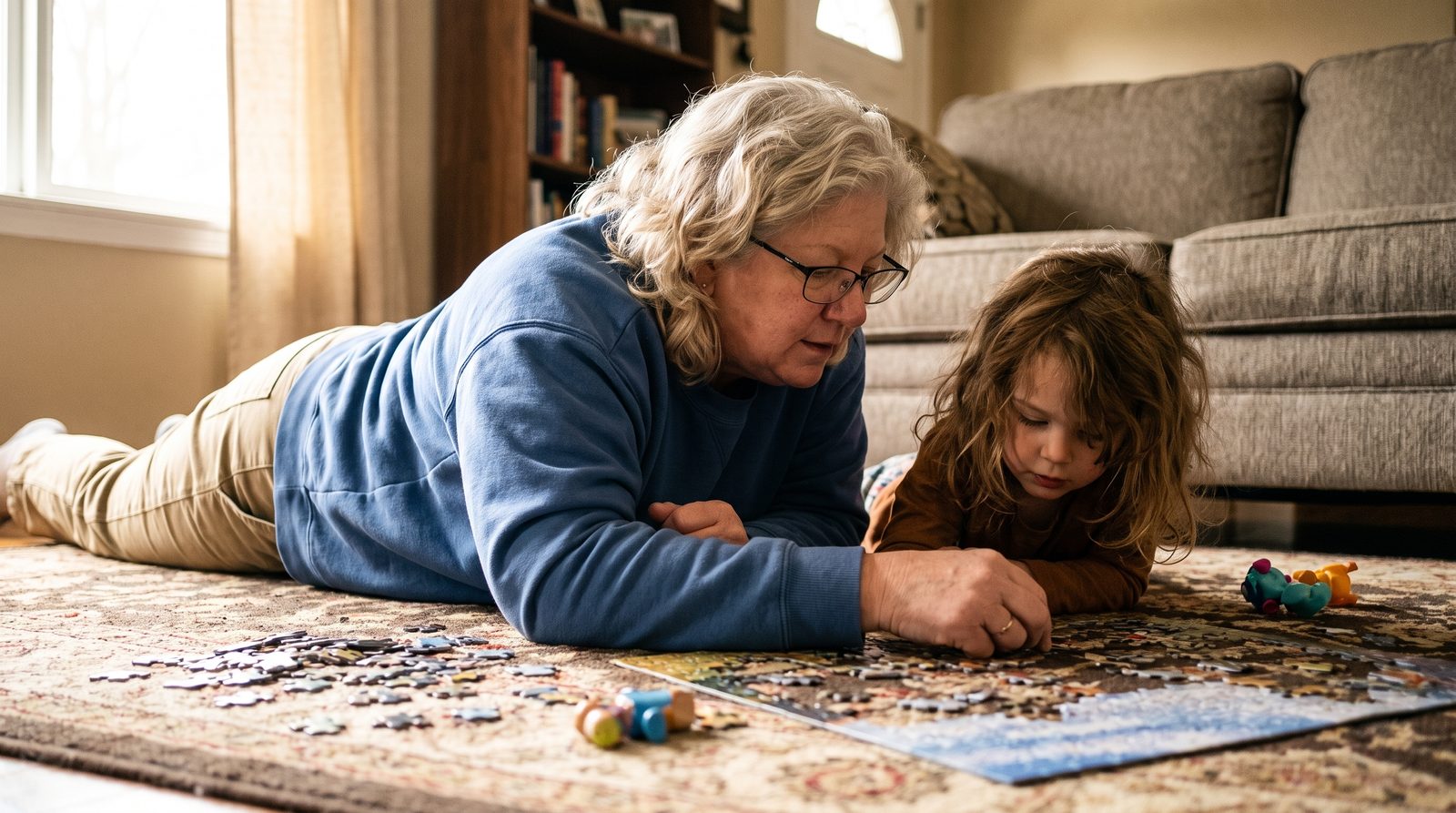
Nora's puzzle
Three weeks ago I let myself into my mother's house and she was on the living room floor.
On her stomach, in her good trousers, with a four-year-old and about two hundred puzzle pieces. She looked up at me the way you look up when you have been caught doing something you are not supposed to be able to do any more.
I stood in the doorway longer than I needed to.
I want to say something now to whoever is reading this and recognises that floor.
I know what you are actually afraid of, and it is not the burning. You have learned to live with the burning. You have been living with it for years, and you are tougher about it than anyone in your family understands.
What frightens you is the arithmetic. That the list of things you say no to gets one item longer every season. The floor, then the stairs, then the garden, then the trip. That one day you become the grandparent who watches from the chair — and that the people you love will slowly stop asking you, not because they stopped wanting you there, but because they are kind, and they noticed, and they are trying to spare you having to say no again.
I am not going to tell you that this will happen to you. I do not know you, I have not examined you, and no honest physician would say it to frighten you into buying something.
But I watched my mother believe it. I watched her make herself smaller one ordinary thing at a time, without a word of complaint, with a neurologist for a son who did not have an answer for her.
She has one now. And she is back on the floor.
That is the reason I am writing this tonight instead of finishing my notes.
Not to frighten you. You have been frightened plenty, usually by people with far less standing to do it than me.
I am writing because the thing my mother was quietly afraid of turned out not to be permanent — and nobody told her that. She spent three years believing the floor was gone. I had to find out otherwise at two in the morning, at my own desk, fifteen years later than I should have.
So let me be the one who tells you.
Your nights can be different from this. And your floor is still there. — Dr. Alan Reese, MD
Reader Offer — Solo Recovery (1 Wrap)
Just $109.97 — save $70
About one clinic session · Symmetry Pair for both ankles $149.97
- CE Certified
- FCC Certified
- RoHS Certified
- Free Shipping
- 60-Day Money-Back
Research References
The sources below support the mechanism described in this article. They are listed so you can read them yourself.
- Where the posterior tibial nerve lies at the ankle — Ultrasound study of 100 healthy volunteers. The nerve trunk sits within the soft tissue behind the inner ankle, and its position varies considerably from person to person. PMC12732173
- Where the nerve divides — Cadaveric anatomical study. In the great majority of people, the nerve branches inside the tunnel behind the inner ankle bone. PMC3718430
- Blood supply and nerve signalling — Animal study. Dysfunction in the small vessels supplying nerve tissue was detectable before any measurable slowing of nerve conduction — consistent with supply failing first and signalling failing after. PMC2477757
- Photobiomodulation therapy for peripheral neuropathy — RCT, n=200, Type 2 diabetic peripheral neuropathy. PBMT (10 sessions) significantly reduced neuropathic symptoms and improved protective foot sensation vs. control. PMID 40090424
Medical & Health Disclaimer
The information and other content provided on this page, or in any linked materials, are not intended and should not be construed as medical advice, nor is the information a substitute for professional medical expertise or treatment. Individual results vary. This device is not intended to diagnose, treat, cure or prevent any disease. If you or any other person has a medical concern, consult a health care provider before beginning any new therapeutic regimen — particularly if you have diabetes, take anticoagulants, or have open wounds or active infection at the treatment site.