
Nerve Health · Burning, Freezing & Numb Feet
3 Things Nobody Explains About Burning, Freezing or Numb Feet
Why they take over at night, why the same foot can feel frozen and burn, and why the floor gets harder to trust.
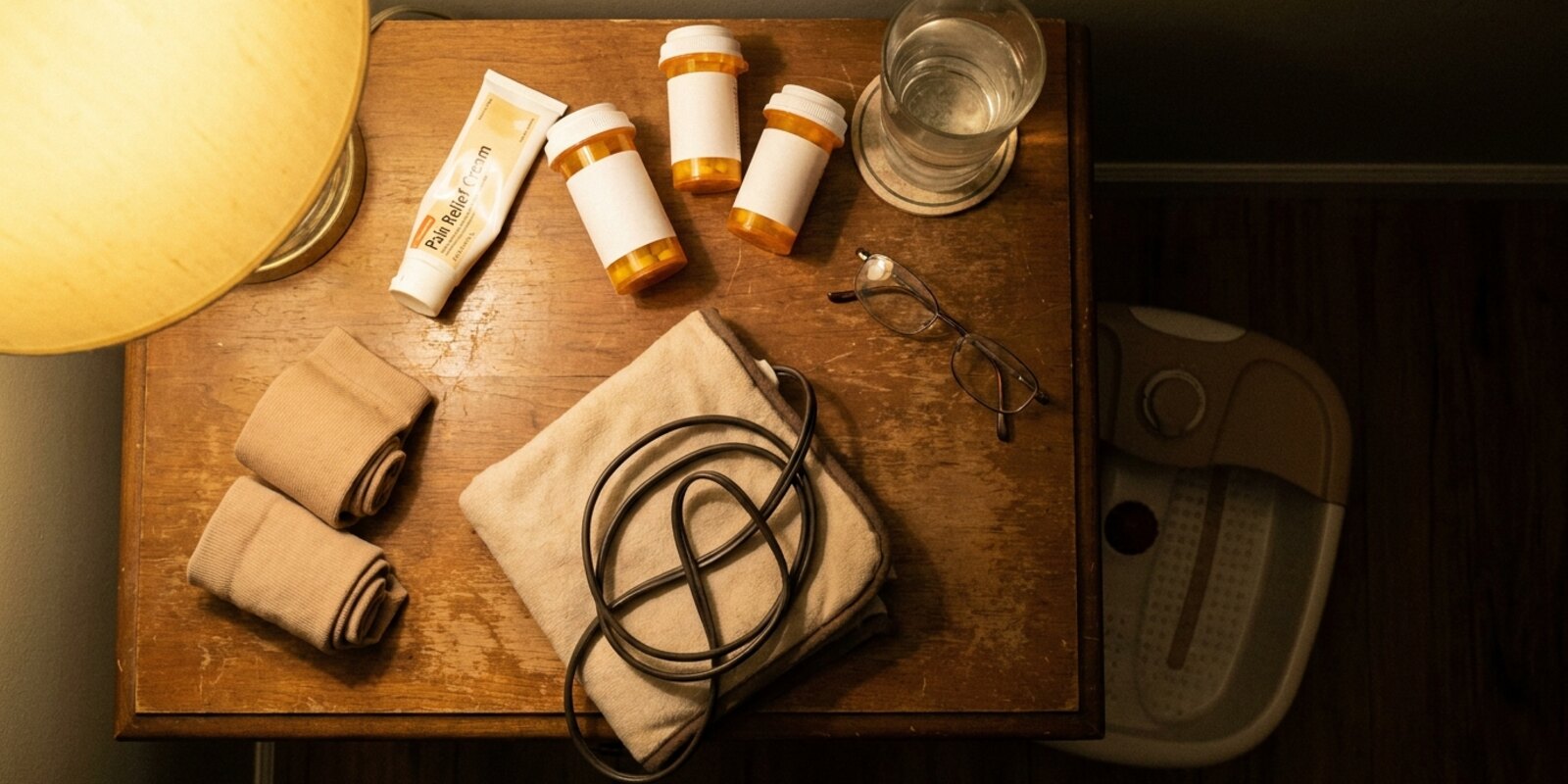
Nobody describes this in tidy medical language.
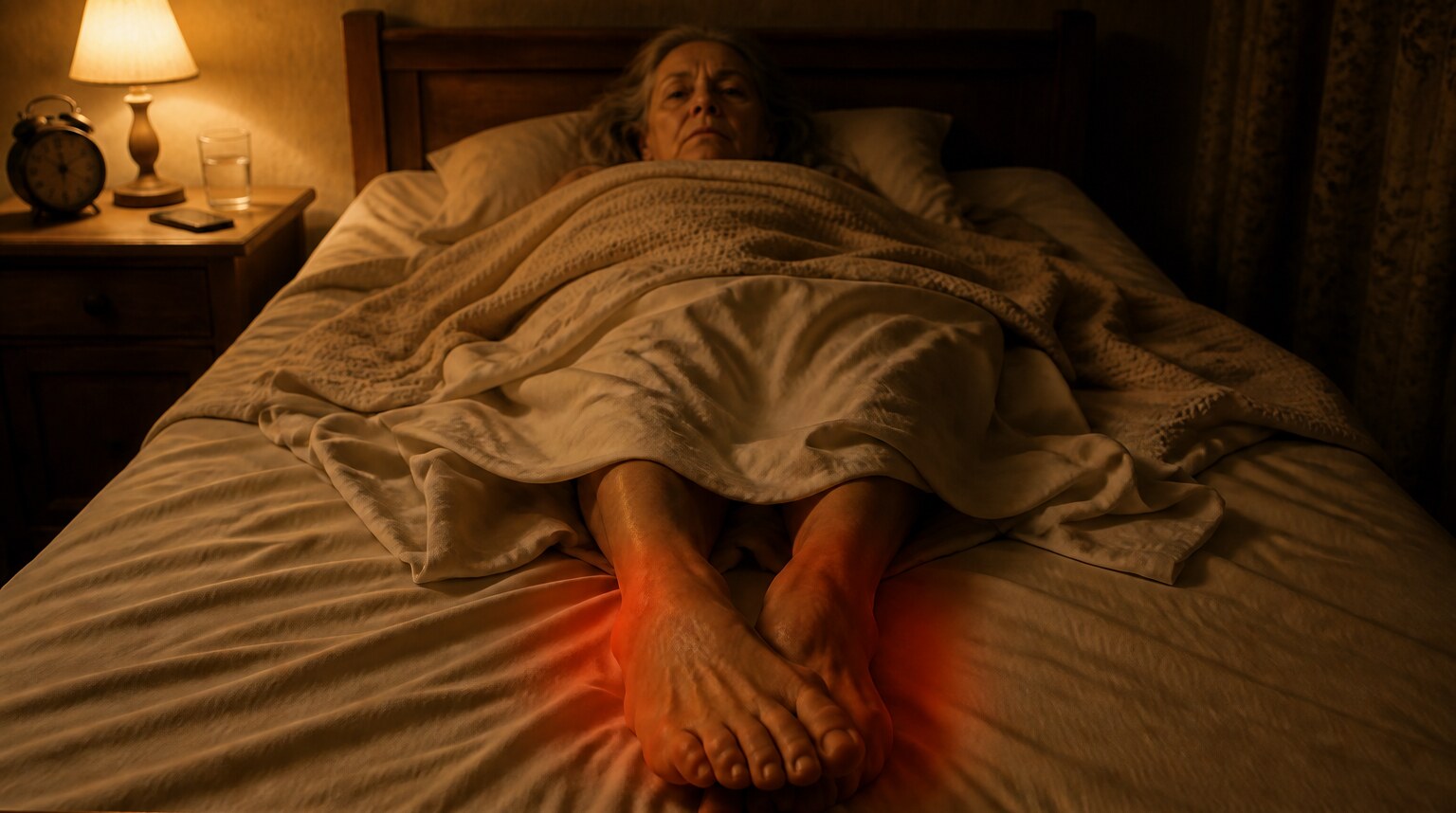
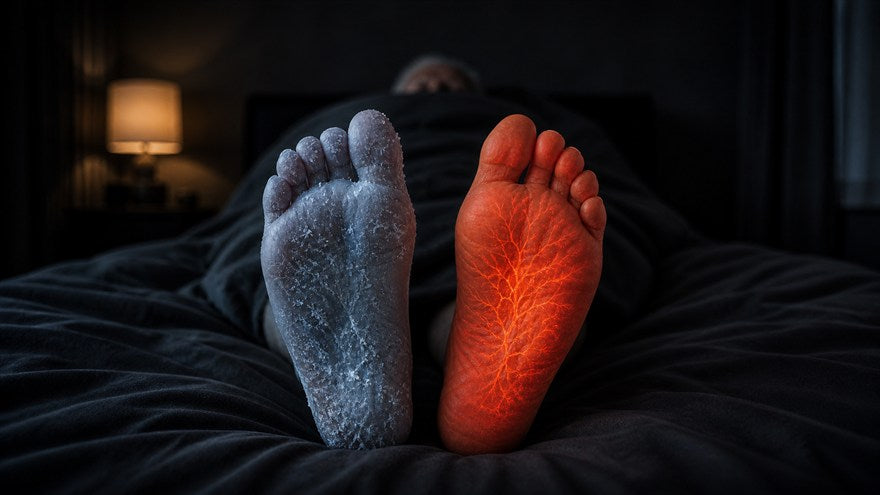
One foot burns under a cool sheet. The other feels frozen — and when someone touches it, they say it feels perfectly normal.
Then something else starts. You put your foot down, and you still look, to be sure it landed where you meant it to.
Some people reading this have diabetes. Some first noticed it after chemotherapy. Many were told age, or circulation, or simply we don't know.
But the real cost is not what your feet feel.
At night, they take your sleep. In the daytime, they take your confidence on your own floor.
Here are the three things behind that. Almost nobody explains them.
Why burning and tingling take over at night
You already know the routine.
Feet out from under the blankets. The thermostat at 75 so you don't need covers at all. A frame to hold the sheet up off your toes. Five minutes with your feet in cold water, just to get close to sleep.
Here is what does not add up.
Nothing happened to your feet at two in the morning. They are the same feet that carried you at noon.
Two things change at night. Neither one is your imagination.
First, the line goes quiet. All day, the nerves in your legs are busy. Shoes. Your weight. The floor. Standing up, sitting down. All of that traffic competes with the faulty signal.
At night the traffic stops. The faulty signal has the whole line to itself.
Second, lying down warms your skin. Your body pushes blood toward the surface to cool you for sleep. Warmer skin makes an already irritated nerve fire harder.
So the burning gets louder at exactly the hour everything else goes quiet.
That is why the honest cost of this is not really pain. It is sleep.
Forty minutes to fall asleep. A jolt at three. Then a whole day run on whatever rest was left over.
There is a name for that: sleep starvation. Most people just call it a normal week.
Hold on to the first reason. It comes back later — because the thing that makes your nights worst is also the thing that gives us somewhere to work.
Why the same feet can feel freezing, burning — or both
If your feet are cold rather than burning, you have probably noticed something.
Almost nothing written about nerve trouble is written about you.
You are not a rare case. And you are not imagining it.
There are two temperatures here, and they are not the same thing.
One is the temperature your skin actually is. The other is the temperature your nerves report to your brain.
Small nerve fibers carry that report. Small fibers are the thinnest nerve endings in your skin, and they handle temperature, burning and pain.
When those fibers are damaged, the report comes back wrong. Your foot feels packed in ice. Someone touches it and says it feels normal.
You are both right. One of you is describing the skin. The other is describing the message.
Now the second half — and this is the part nobody tells you.
Those same small fibers also help control the tiny blood vessels in your skin. One bundle of fibers, two jobs.
So when they are damaged, two things can go wrong at once. The report is wrong. And the vessels stop opening the way they should, so less warm blood reaches the surface.
That is why one person feels frozen with normal skin. Another has feet that really are cold to the touch. And a great many people have both at the same time.
It also explains the thing that made you give up.
Socks, blankets and down booties do not make heat. Nothing in them is warm on its own.
All they can do is hold on to the heat your own body is putting out.
That is exactly the problem. A cold foot is not putting out much heat, so there is nothing for the sock to hold.
Put a cold foot into a cold sock, and all you have done is seal the cold in.
That was never you buying the wrong socks. That was fifteen pairs of the wrong tool.
And this is where the night gets taken from this group too. Not by pain — by feet that never warm up enough to let you fall asleep.
One thing worth saying plainly. A foot that turns suddenly cold, pale, blue or one-sided is a different matter. So is a sore that will not close. Get those looked at, rather than filing them under neuropathy.
What a cold foot needs is not another layer. It needs warmth brought to it, from outside, at a level you control.
Why numb feet make the floor harder to trust
Your feet are not only the part you stand on. They are sensors.
With every step, they send three reports up to your brain.
Where the floor is. How your weight is spread across it. Whether the ankle has started to roll.
You never notice those reports arriving. You notice when they stop.
Numbness is not a dead foot. It is a missing report.
And a brain that is missing one report does what any of us would do. It uses the eyes instead.
That is why you look down now. That is why a dark hallway feels different than it used to. That is why closing your eyes to rinse your hair in the shower stopped being relaxing.
You can check this while you sit here. Stand up, feet together, and close your eyes for ten seconds.
If you start to sway, that is not weakness and it is not simply your age. That is your brain losing the report from your feet, and reaching for your eyes to replace it.
It also explains where people actually trip.
Not on icy sidewalks. On the strip between the kitchen tile and the hallway wood. On the corner of a bathmat. On the edge of a chair they were sure was underneath them.
Then a second thing starts, quieter than the first.
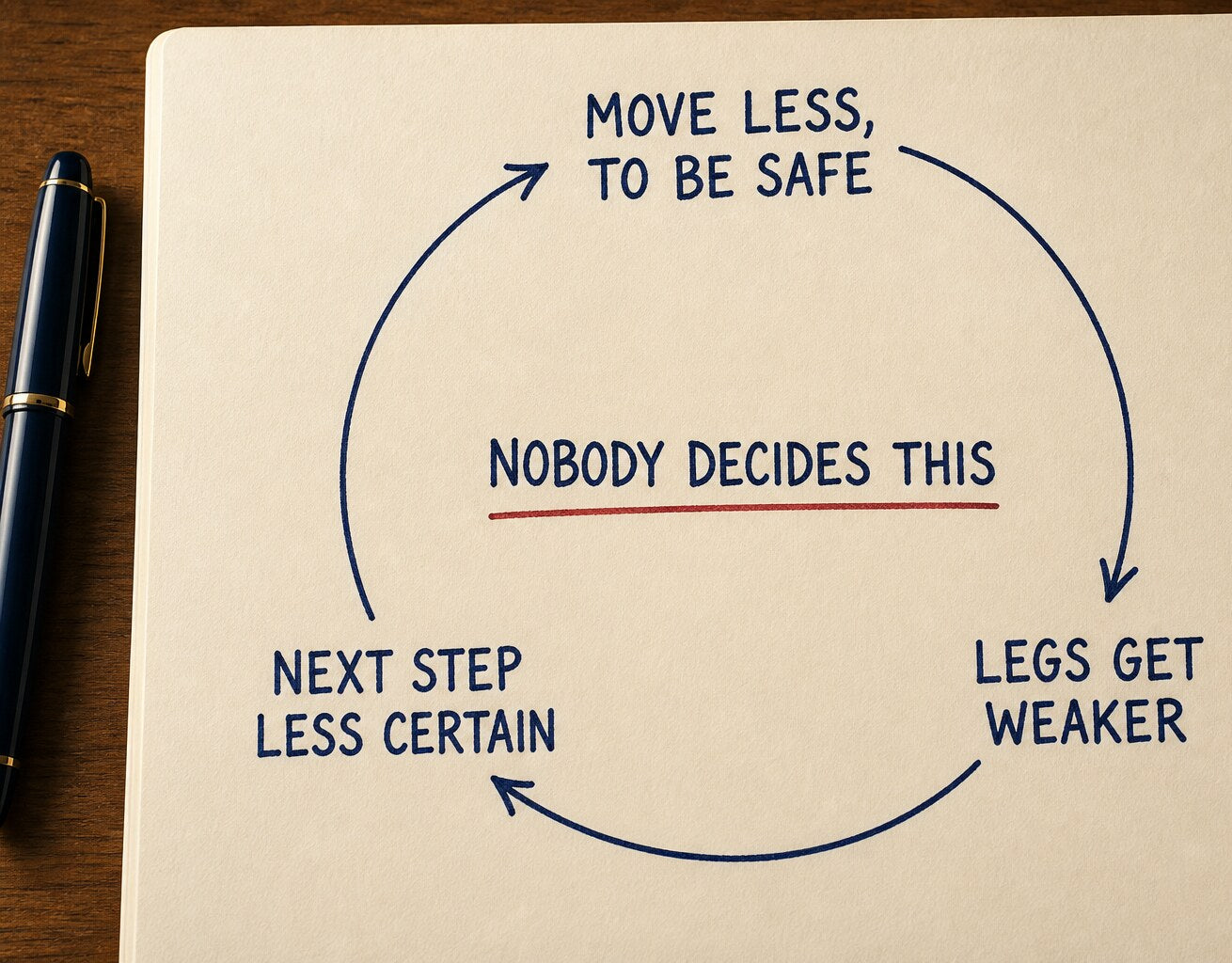
You move less, to be safe. Moving less makes your legs weaker. Weaker legs make the next step less certain. Less certainty makes you move less again.
Nobody ever decides to do that. The list just gets one item longer every season. The stairs. Then the walk. Then the dog.
Here is the part worth holding on to. That loop runs on movement and confidence — and those are the parts you can still put your hands on.
One honest note first. If your foot has started catching, dragging, or giving way on its own, that is a different problem. That one needs a doctor, and possibly a brace. Not a wrap.
One place all three point to: The Ankle Choke Point
Three different complaints. One place worth looking at.
Just below the bump on the inside of your ankle, there is a passage. It has a name: the tarsal tunnel.
Bone on one side. A tight band of tissue stretched across the other.
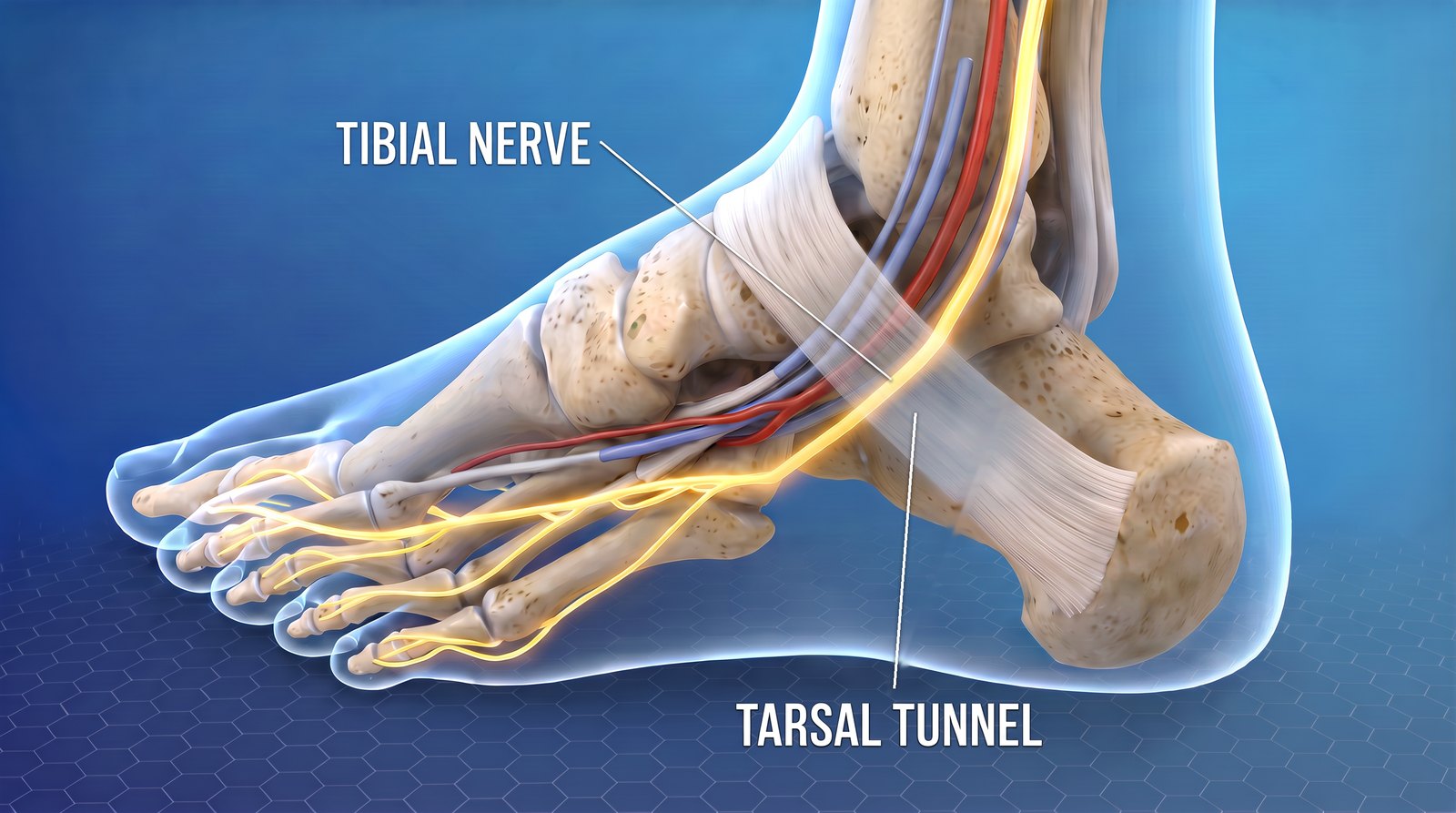
Inside it, the tibial nerve — the nerve that carries every signal to and from your heel and sole — shares that space with an artery, its veins, and three working tendons.
They all pass through at the same time. And that tunnel cannot widen when more room is needed.
So the nerve that serves your whole foot, and the blood supply that feeds that nerve, are squeezed through the same narrow gate.
It is the last checkpoint on a very long line. It is also the tightest.
That convergence of pressure and reduced supply is what we call The Ankle Choke Point.
A nerve that is squeezed and underfed does not simply go silent. It misfires.
It burns when there is no heat. It reports ice when your skin is ordinary. And it stops sending the one report you actually needed — where the floor is.

Your nights, your cold feet and your footing are not three separate problems.
They are three ways one nerve tells you it is not getting enough of what it needs.
Nobody widens that passage at home. But the passage is not the only thing you can reach.
You may not be able to remove the pressure at home. But you can stop leaving the nerve inside it running on empty.
Why so much of what you tried missed it
Think about what you have already been through.
Pills work on the signal, up in your brain. Creams and patches sit on the skin. Orthotics change the arch. Braces hold the joint still. Compression squeezes a space that already has no room to spare.
Floor massagers knead the sole, because the sole is where it hurts. But the sole is not where the passage is — and if kneading has ever felt like razors on skin that already hurts to touch, you know it was never going to be the answer.
None of them was built around the last mile: getting the supply through that gate to the nerve, and then helping the nerve's own cells use what arrives.
Your body still has what that nerve needs. Too little of it is getting through.
Three jobs, one address: OPEN · MOVE · CONVERT
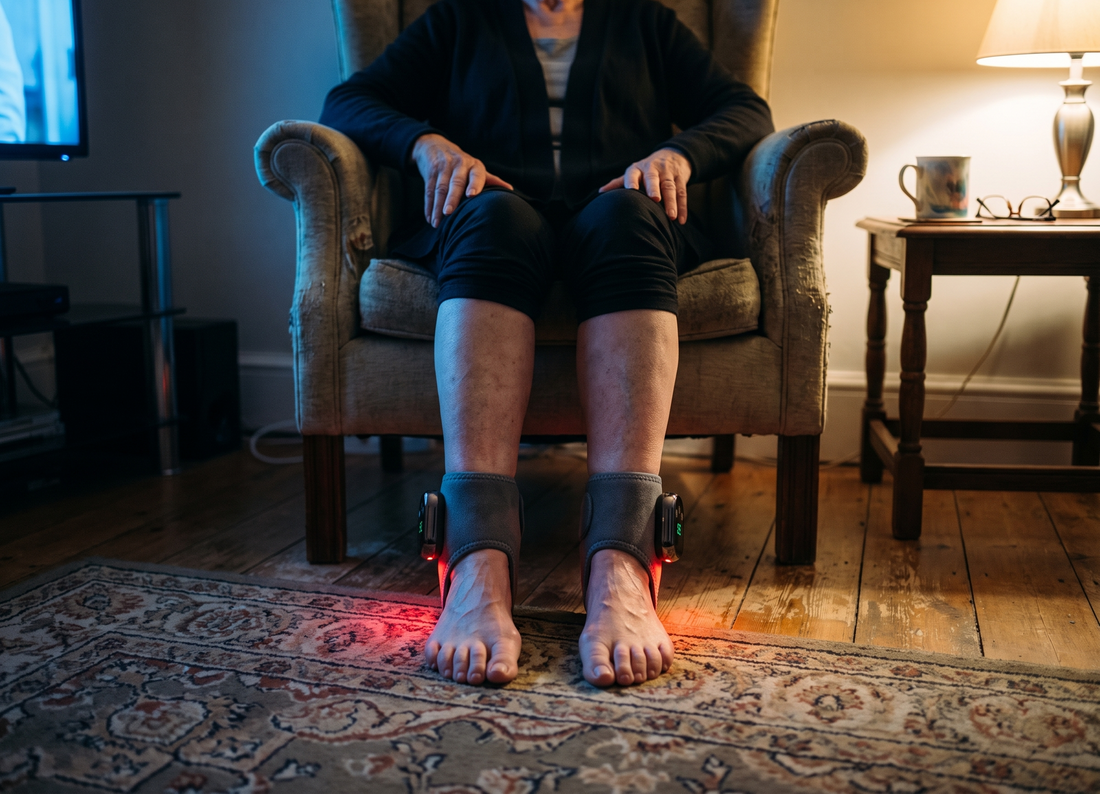
That is the design of the TheraPrime Triple-Therapy Recovery System — three clinical modalities built into one wrap that fastens around the ankle.
Three separate jobs. One address. Twenty minutes, sitting in a chair.
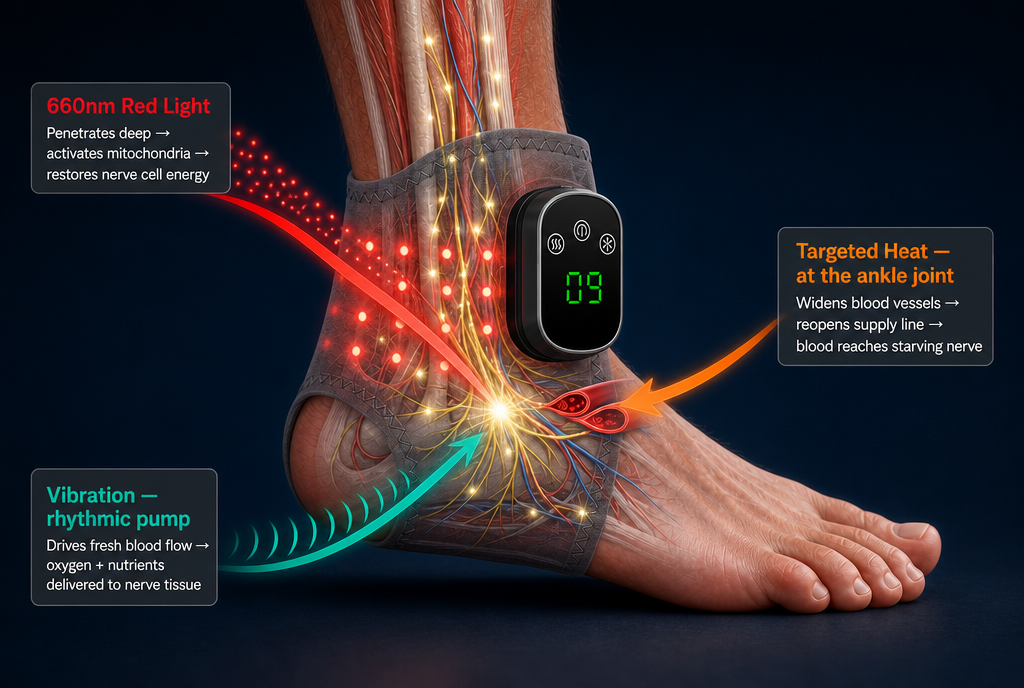
OPEN — controlled warmth. Warmth widens small blood vessels, so more of the supply gets through the passage.
Notice where the warmth goes. The ankle. Not your burning soles. Heat on the sole makes things worse for a lot of people, and if you found that out the hard way, you were not imagining it.
For a genuinely cold foot, this is the difference that matters. It brings warmth in, instead of trying to trap warmth that was never there.
Now the part that matters most if you cannot feel temperature well.
You set the level yourself, and the lowest setting is barely warmer than your own skin. Start there. Most people never need to go higher.
The heat also stops on its own after twenty minutes. You do not have to notice that it is time to stop. That decision is not left to a foot that cannot feel.
MOVE — gentle vibration. This one does three jobs, and the order matters.
It moves the supply. Blood does not climb back up out of your feet on its own. Your calf is the pump, and every step you take is one beat of it.
Sitting still switches that pump off. Vibration keeps a rhythm going around the ankle, so the oxygen and nutrients your nerve is waiting on keep moving through the passage while your legs are resting.
It gives the faulty signal some competition. Remember the first reason your nights are worst — the line is empty, so the bad signal owns it. Vibration puts real sensation back on that line. A woman living with the same burning and tingling said it better than any textbook:
Sometimes the gentler vibrations feel like they give my nerves something else to focus on.
And it puts sensation back where you have been missing it. Go back to the third thing on this page. What you lost was the report your feet send up to your brain.
Vibration is a report. Real sensation, arriving on the line that had gone quiet.
The people living with this worked that out long before anyone sold them anything. The ones who get steadier are the ones who keep moving. One of them, after a month of walking every day — “I have not used a cane for months now.”
Vibration therapy has been through controlled trials in diabetic nerve pain as well. Balance scores improved. So did how well their feet could feel.
That is the part worth holding on to. Feet like yours still answer when something gives the nerves real sensation to work with.
You will never get that from a sock.
CONVERT — 660nm red light. This is the part no heating pad and no massager has. It is also the part that works on the long game.
Getting oxygen and nutrients to the nerve is delivery. Delivery is only half the job. The cells still have to turn what arrives into energy they can use.
That happens in the mitochondria — the tiny power plants inside every cell. The fuel they make is called ATP. ATP is what a nerve actually runs on.
Red light at 660nm is studied for its effect on exactly that step.
Warmth and vibration work on how your ankle feels tonight. The light works on what the tissue there has to spend, night after night, to heal itself.
It does not add supply. It helps the cell get more usable energy out of whatever supply is already arriving — which is why it still has work to do on the nights you run it on its own.
Heat opens the route. Vibration keeps the supply moving. The light helps the cell use what arrives.
Open the route. Move the supply. Power the nerve.
One thing this is not. It is not a laser, and it is not a package of clinic appointments sold to you twelve at a time. It is an LED you own, in your own house, on your own schedule.
Nothing rolls, kneads or digs into your sole. It fastens at the ankle, and each mode switches off on its own, so you use only what your foot will tolerate.
What progress usually looks like
Nerves do not recover overnight. Heat and vibration are what you notice first. The light works more quietly, on the energy nerve cells run on.
Week 1 — you feel the therapies. Warmth and gentle vibration settle around the ankle. The twenty-minute evening routine starts becoming automatic.
Weeks 2–3 — the nights begin to shift. Flare-ups may come less often. Longer stretches of sleep before your feet wake you.
Weeks 4–6 — beyond the session. Pins and needles may stay quieter between uses. Standing at the sink, or walking out to the mailbox, begins to feel easier.
Week 8 and on — a better baseline. More good nights. Fewer nights run by your feet.
Everyone's timeline is different. Before your first session, write down how long it takes you to fall asleep and how many times you wake. Then use it daily for the full 60 days, and judge it by what changed — not by how night three felt.

Dorothy K., 68 · Richmond, VA
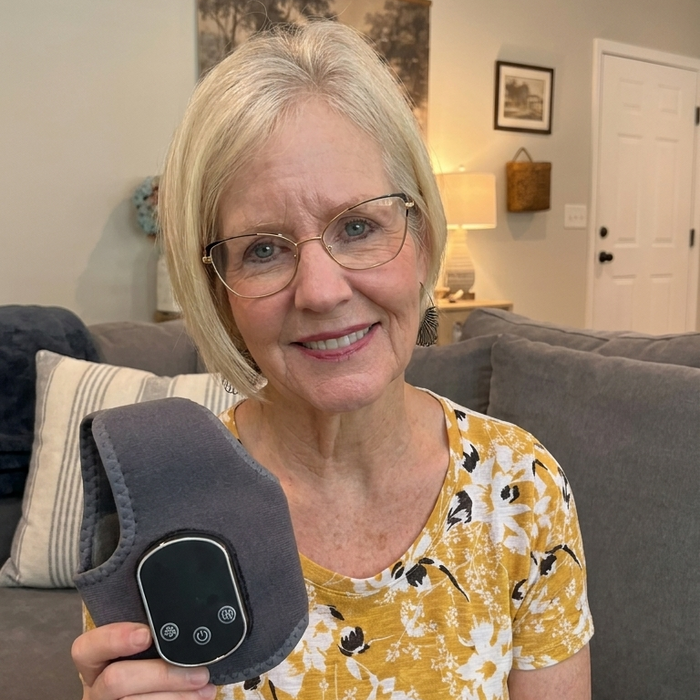
“I almost scrolled past. I have a drawer full of things that were supposed to help. The article told me to write two numbers down first, so I did — it was taking me about forty minutes to get to sleep. What I watch now is not a miracle number. It's whether the whole evening still has to be built around my feet.”
Thomas B. · Jacksonville, FL
“Mine are the cold kind, not the burning kind, so most of what I read never fit me. I had three pairs of wool socks and a heated blanket, and my feet were still blocks of ice at bedtime. What I wanted was warmth I could switch on at the ankle for twenty minutes, then switch off. I still get cold nights. But we have stopped heating the whole house for two feet.”
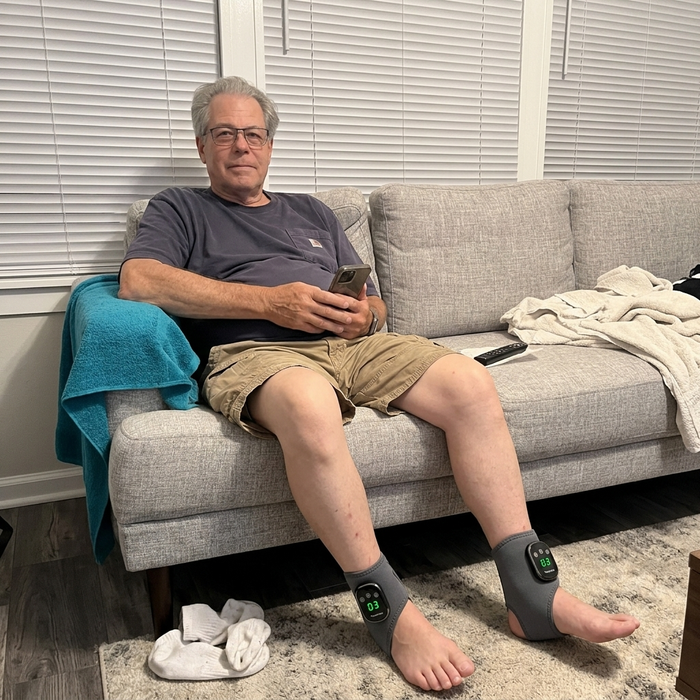

Linda R., 71 · Tampa, FL
“My neuropathy came after chemotherapy, not diabetes, so I nearly closed the page. Almost everything I owned worked on the sole, where touch already hurt. This one sits at the ankle instead. I also appreciated being told up front that I would not feel the light — I turned it on in a dark room the first night just to see the red for myself.”
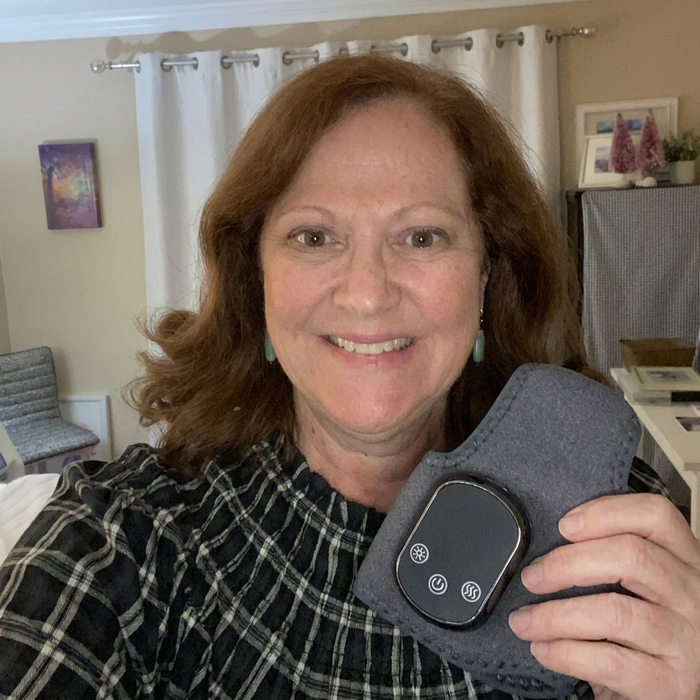

James W., 65 · Pensacola, FL
“The part nobody around me understood was why I kept looking down. I could not always trust that my foot had landed where I thought it had, especially going to the bathroom at night. I use it in the recliner after supper. My doctor had me start with the heat off because of the numbness, and that was the right call.”


Margaret S., 67 · Atlanta, GA
“Those foot massagers kneading my soles felt like razors. I gave two of them away. This goes around the ankle and nothing rolls underneath me. Heat and vibration switch separately, which matters — 'gentle' is not optional when your feet react to almost everything.”
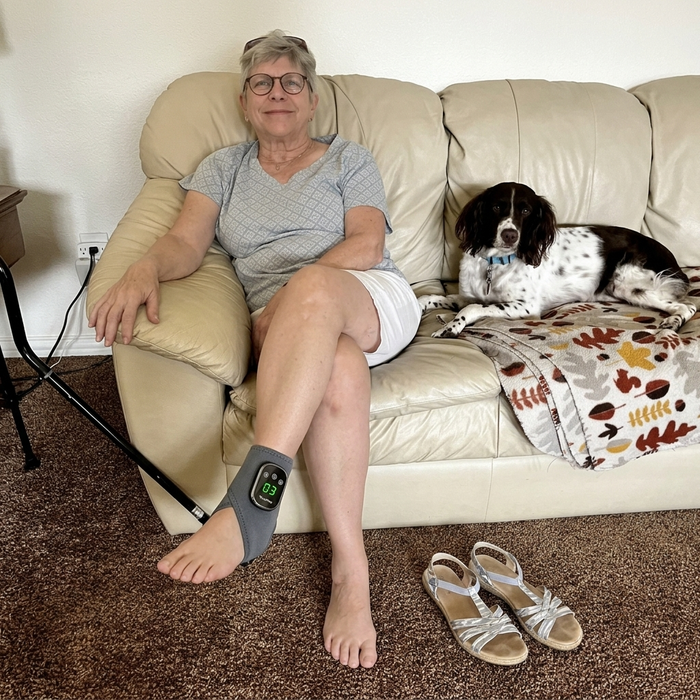
What it costs
A course of light therapy at a clinic gives you one of these three things. Twelve times. Each one an appointment, a drive and a separate bill.
This gives you all three. Every evening. In your own chair, for as long as you want it.
Most people with this have it in both feet. That is not bad luck. Both feet sit at the far end of the same long supply line, so both tend to come up short at the same time.
Which brings up the practical question nobody mentions until after they order.
With one system, a both-feet routine is two sessions, back to back. Forty minutes every evening instead of twenty.
That is usually the thing that decides whether a routine is still going in week six.
The second ankle costs $40.
Both ship free. Both carry the 60-day full money-back guarantee — no questions asked.
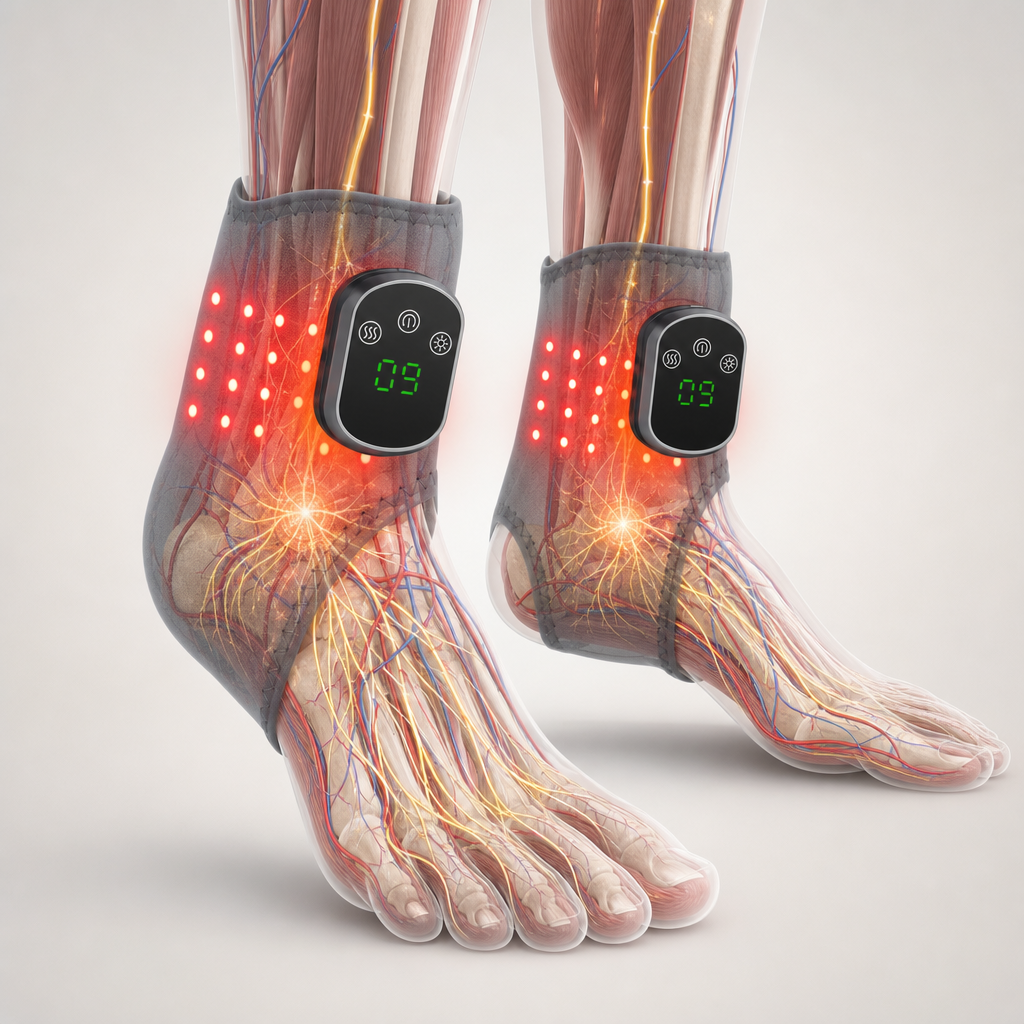
Free shipping · 60-day money-back guarantee
Burning and freezing are what get your attention. Sleep and footing are what they quietly take.
First it is the night spent hunting for a position your feet will tolerate.
Then it is the hand on the wall. Then the stairs you think about before you climb them. Then the dog walk that becomes somebody else's job.
That list got longer one item at a time. It can get shorter the same way.
Not tomorrow. But a night that costs you forty minutes instead of two hours is a real night. A hallway you cross without reaching for the wall is a real hallway. That is the size ordinary life is actually made of.
Twenty minutes. In a chair. While the television is on.
Do it tonight. Do it again tomorrow. Keep doing it, and stop leaving the nerve at the narrowest point on the line running on empty.
Everything you want back is on the other side of staying with it.
From $109.97 · Free shipping · 60-day money-back guarantee
Reader Offer — Symmetry Pair, both ankles
$149.97
Twenty minutes a night, not forty. The second ankle costs $40.
Get the Symmetry PairResearch References
The sources below support the mechanism described in this article. They are listed so you can read them yourself.
- Posterior tibial nerve at the ankle — ultrasound study of 100 healthy volunteers: PMC12732173.
- Tibial nerve branching inside the tarsal tunnel — cadaveric anatomy: PMC3718430.
- Small-vessel function and nerve signalling — animal study; background on the mechanism, not a study of this device: PMC2477757.
- Photobiomodulation in type 2 diabetic peripheral neuropathy — randomised trial of the modality: PMID 40090424.
- Vibration therapy in painful diabetic peripheral neuropathy — randomised controlled trial, 26 adults (mean age 60), six weeks of whole-body vibration. Improved single-leg stance and timed up-and-go scores, vibration perception threshold at the toe and metatarsal head, pain and quality of life. A clinic vibration platform, not this device: PMID 32550157.
Medical & Health Disclaimer
This article is for general education and is not medical advice. TheraPrime is a general wellness device. It is not intended to diagnose, treat, cure or prevent peripheral neuropathy, tarsal tunnel syndrome, falls, or any other disease or injury. Individual results vary. Seek medical care for a suddenly cold, pale or one-sided foot, a change in colour, a wound that will not close, new weakness, a foot that catches or drags, or numbness that is worsening quickly. If you have diabetes, reduced sensation, an open wound, an active infection or a circulatory condition, speak with a qualified clinician before starting heat or vibration. If a surgeon has recommended a procedure for your ankle, nothing on this page replaces that conversation.