
Plantar Fasciitis
The Reason Your First Steps Every Morning Feel Like Walking On Glass — It Has Nothing To Do With Your Foot
A retired librarian explains why three years of treatments all aimed at the wrong place — and what finally addressed the actual source of morning heel pain.
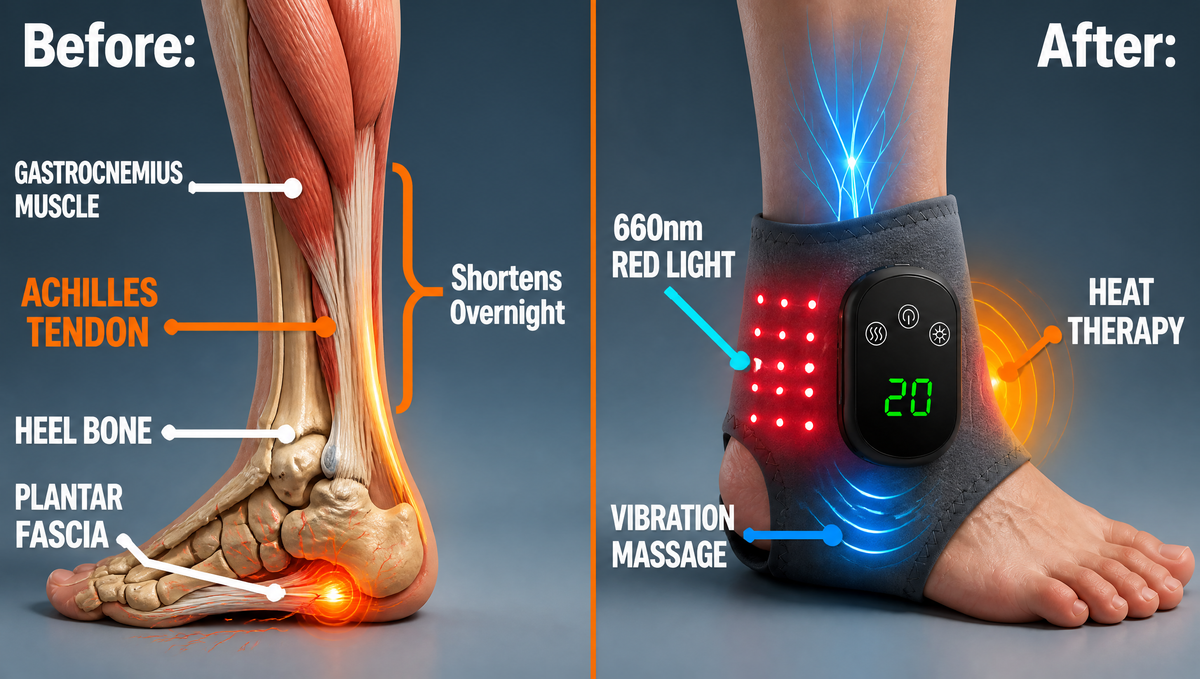
The first thing I do every morning is brace for it.
I sit on the edge of the bed. Both feet hover above the floor. I take a slow breath.
And then I stand.
That first step — heel down — feels like someone drove a nail through the bottom of my foot.
If you know this feeling, you stopped scrolling the second I described it.
My name is Patricia. I'm 64, recently retired after 31 years as a high school librarian in central Texas. On my feet most of the day, every day — walking the stacks, standing at the reference desk, chasing kids out of the biography section before closing.
I thought I had tough feet. I had no idea what was coming.
The pain started three years ago, gradually. A little stiffness in the morning. An ache after long walks. Nothing that stopped me. Then one morning it did — and it never really stopped again.
The treatments that never reached the problem
I did what you're supposed to do.
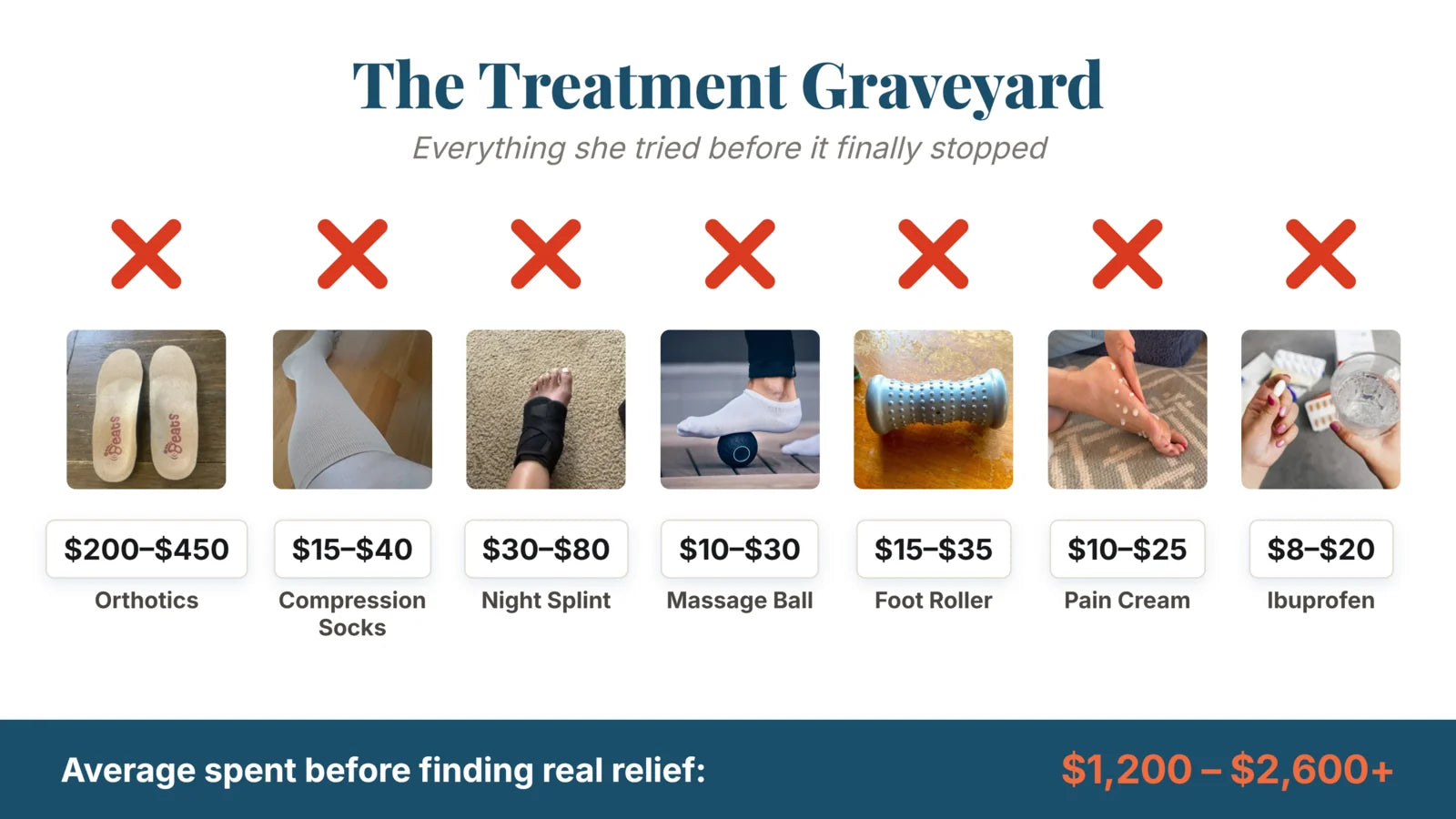
Custom orthotics — $450, two weeks to arrive. They helped for maybe six weeks. Then I was back to bracing every morning.
A night splint for three months. My husband slept in the guest room because I kept waking him repositioning it. My plantar fascia felt marginally better. My sleep didn't.
A cortisone injection. Eight weeks of real relief — I thought I was fixed. Then it came back, harder. My podiatrist said I could try a second one, but at some point the injections do more harm than good.
Physical therapy twice a week for fourteen weeks. It helped more than anything. It cost $1,200 in copays. And the moment I stopped, the progress started fading.
The foot roller. The frozen water bottle. The arch insoles. The compression socks.
None of them answered the question that was quietly becoming the loudest one in my head:
Why is it still happening?
My husband and I had planned a retirement trip to the National Parks. We'd talked about it for years — Zion, Bryce Canyon, Arches.
We went to Zion last October. I made it to the visitor center and had to sit down. My heel was burning too badly to go further. He went ahead. I sat by the window and waited.
He texted me photos from the canyon rim.
I smiled at every one. I didn't tell him I was done booking trips.

The thing about this kind of pain is that it's invisible most of the day. By noon, after I'd been moving for a while, the heel would loosen. I'd walk fine through errands. Then I'd sit down for lunch — forty minutes — and when I stood again, the knife was back. Not as bad. But back.
By four in the afternoon, after a day of regular walking and standing, the burning would settle back in. I learned to take shoes off the second I got home. My feet didn't want to be in shoes anymore.
What nobody saw was the six minutes every morning — sitting on the edge of the mattress, both feet hovering, counting in my head before I put weight down. Nobody saw me grip the chair arm every time I stood up from the lunch table. Nobody noticed me calculating the walk to the bathroom after sitting for a while.
My sister-in-law suggested yoga. My neighbor offered to pray for my "sore feet." A friend told me to try glucosamine. I smiled at every suggestion. You get good at that. People who haven't had this don't understand — they see you walking fine at noon and assume it's fine.
Free shipping · 60-day money-back
The discovery
A few weeks after we got back, I posted in a plantar fasciitis support group I'd joined on Facebook. I just typed out what I'd tried and asked what actually worked.
Over 200 replies in two days. I read every one.
Most were familiar — night splints, orthotics, calf stretching, frozen water bottles. Then, on the second day, my phone lit up with a private message.
It was Ellen — the physical therapist who'd led my fourteen-week course. Twenty-three years of clinical experience. She hadn't reached out since my last session ended four months earlier.
"I saw your post," she wrote. "I've been in this group for two years — a lot of my patients find their way here. There's something I should have explained better when we were working together."
Everything we'd done in PT — the calf stretches, the eccentric loading, the manual work — was targeting the right chain, she said. The problem was frequency. Twice a week isn't enough to change tissue that shortens for eight hours every night. The calcaneal attachment — where the Achilles meets the heel bone — needs heat and circulation applied before the first weight-bearing step. Every morning. Not twice a week at a clinic.
She'd been recommending patients look at at-home ankle devices for daily pre-step use. One type kept coming up in follow-up conversations: a cordless device that wrapped directly around the ankle joint — not a foot platform, not a compression sleeve. On the joint itself, where the Achilles attaches.
I looked it up that night. And I finally understood what I'd been missing.
The Achilles Lock
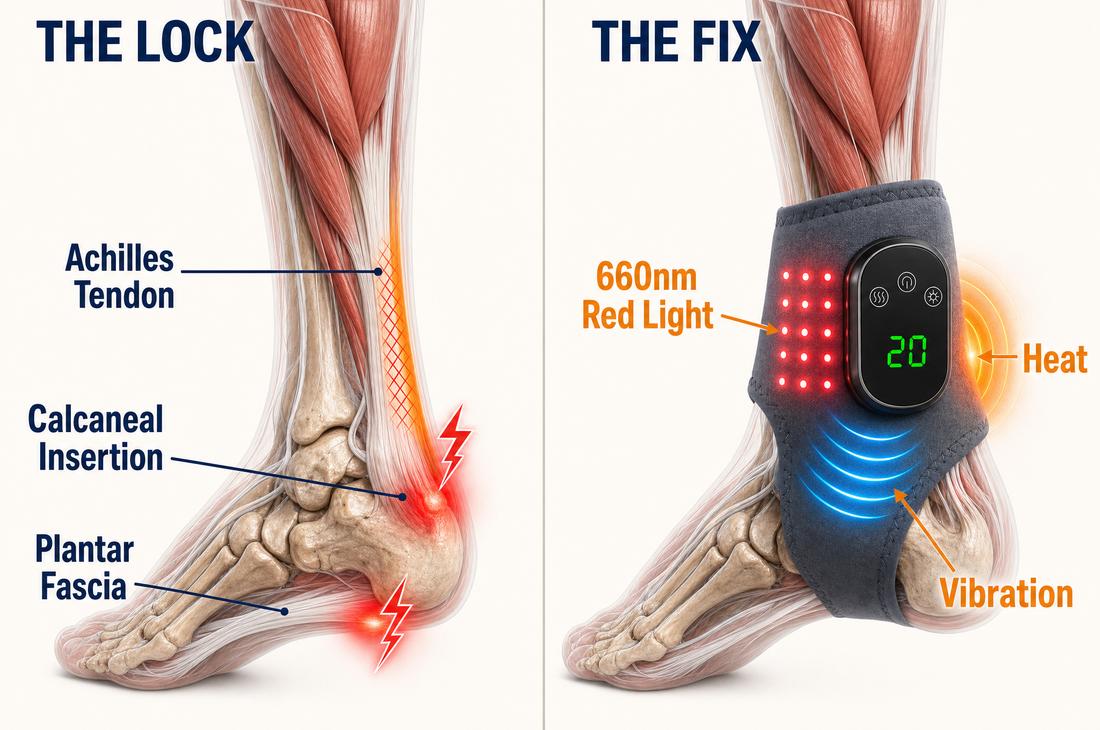
Here's what I'd never quite put together — even after 14 weeks of PT:
Plantar fasciitis isn't really a foot problem. It's an Achilles problem.
The plantar fascia — the band of tissue causing all of this — attaches to the heel bone. But the thing pulling on it, constantly, is the Achilles tendon above. When you sleep, your Achilles shortens. It's been in a shortened position for six to eight hours.
When you stand on that first morning step — before it has a chance to lengthen — the tension travels straight down to the heel insertion. That's the knife.
My calf connects directly into the Achilles. I'd been told to stretch my calves — it helped, briefly. Now I understood why: tight calves pull the Achilles tighter, and tighter Achilles means more tension at the heel on every step. But the stretching never reached the attachment point itself.
But here's what I still didn't understand — and what Ellen explained next.
Free shipping · 60-day money-back
Why won't the Achilles ever release on its own?
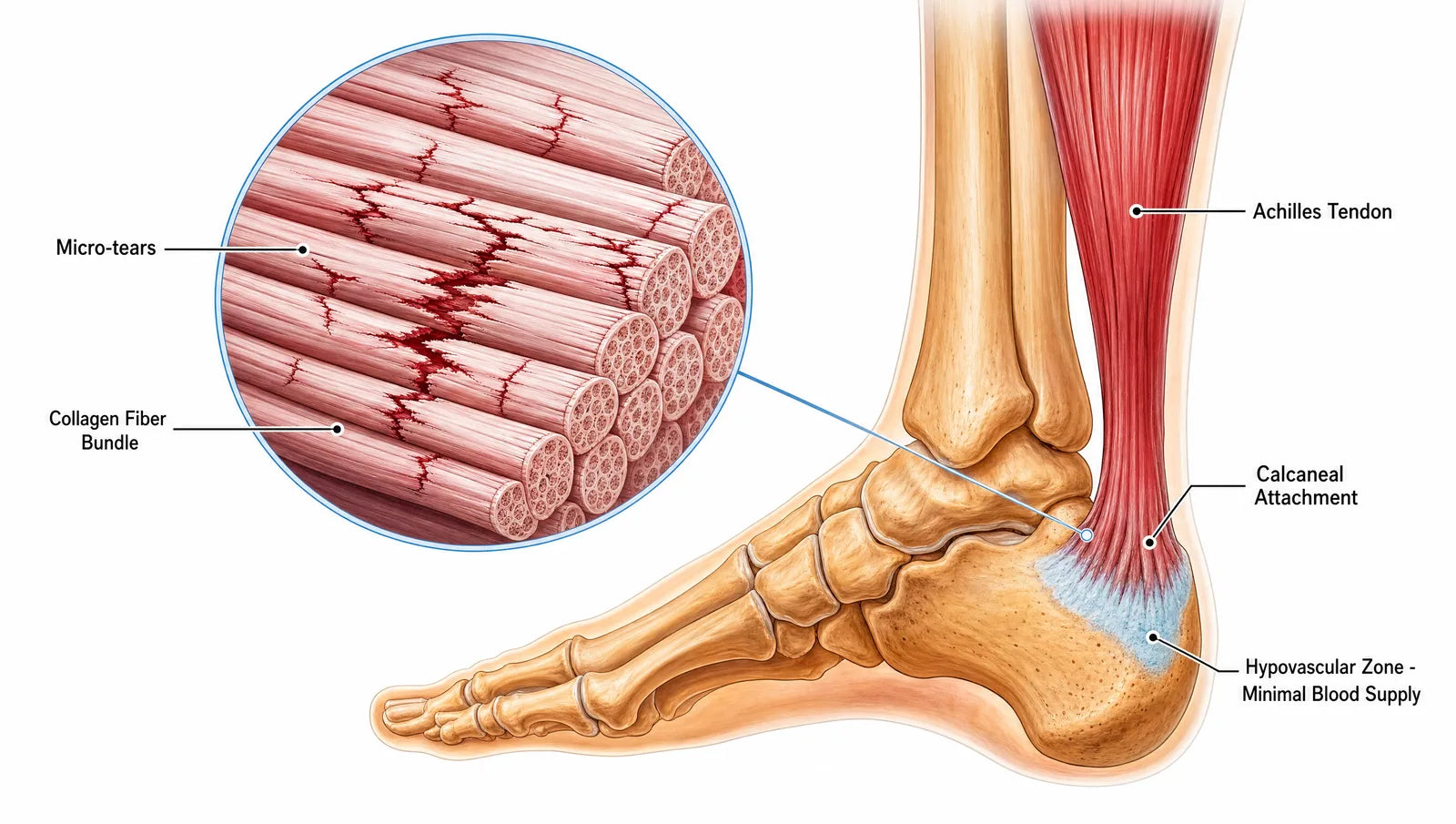
The answer has nothing to do with how much you stretch or rest. It has to do with blood.
The Achilles tendon and the plantar fascia have almost no direct blood supply. Unlike muscle — which heals because blood flows continuously through it — tendon and fascia rely on a thin, slow trickle of circulation. At the calcaneal attachment point, where the Achilles meets the heel bone, that circulation is barely there. Researchers call it a hypovascular zone. A watershed. Tissue that lives on the edge of the supply line.
This is why micro-tears accumulate over years of use without fully repairing. Each morning's tension tears slightly. Each year's load compounds the prior years'. The tissue shortens. Stiffens. Becomes chronically locked — not just overnight, but over years.
Now the cortisone makes sense: it quieted the inflammation, but it never gave the tissue what it needed to rebuild. Now the foot roller makes sense: it mobilized the arch, miles from the attachment zone that couldn't repair itself. Now the stretching makes sense — and its limits. Stretching creates tension along the chain, but it can't deliver circulation into the attachment zone. You can't stretch your way to a blood supply.
Think of it like an old leather boot left out on a cold porch overnight — every night, for three years. By morning, the leather is stiff at the ankle crease. But here's the part I hadn't considered: if you never condition that leather, the fibers don't just get stiff each morning. They dry out. Crack. Stop being able to flex the way they once did. You can warm the leather every morning, but if the fibers underneath were never given what they need to stay supple, you're fighting the symptom, not the cause. The Achilles tendon is collagen. Collagen behaves like leather: it needs warmth at the crease and the circulation to keep the fibers alive.
This is what I now call the Achilles Lock. Not just the tight tendon that pulls every morning — but the deeper lock: tissue that can't repair itself because the circulation it needs never reaches it. And every single device I'd tried was treating the wrong address.
Three therapies, aimed at the actual target
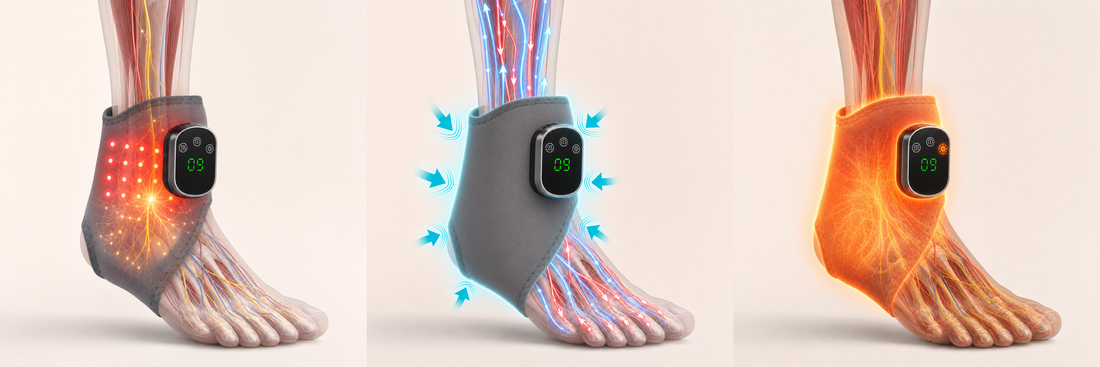
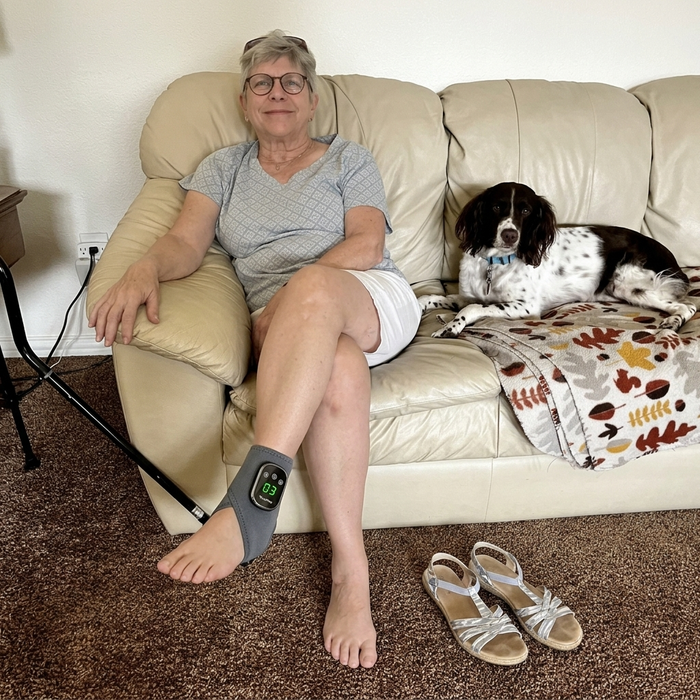
The Triple-Therapy Ankle Recovery System wraps directly around the ankle joint — not under the foot, not around the calf. It delivers three therapies simultaneously to exactly where the Achilles attaches to the heel bone:
Targeted Heat
Applied at the ankle joint itself, to warm the Achilles tissue and restore pliability before your first step. Five precise temperature settings from 40°C to 60°C, with auto-shutoff — designed for consistent, safe heat without monitoring it.
Vibration
At the joint level, to stimulate circulation and release the overnight stiffness that heat alone can't reach — the mechanical pumping that moves blood into a zone that almost never gets it.
660nm Red Light
A specific wavelength that penetrates deep into soft tissue, reaching the tendon and fascial layers directly — activating cellular repair at the attachment zone where the Achilles meets the heel bone.
Ellen made a distinction I hadn't heard anywhere else: heat and vibration open the vessels. Red light feeds the cells that need those vessels to matter. Most devices sold for heel pain do one. This does all three — delivered at the joint, not at the foot.
Free shipping · 60-day money-back
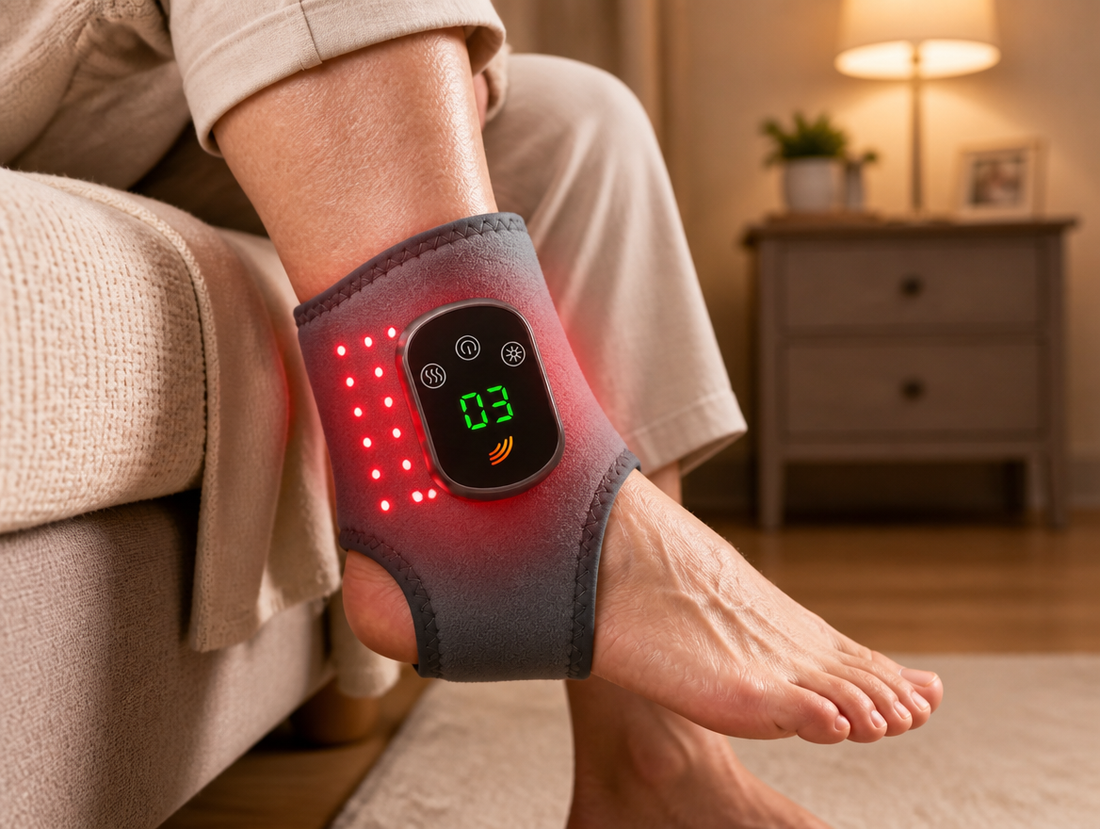
Here's exactly what happens in those 20 minutes
Minutes 1–5: Heat at 40°C begins warming the Achilles tissue at the ankle joint. Collagen viscosity decreases — the tendon becomes more pliable. Blood flow to the attachment zone starts to increase. This is what PT was doing when they applied a heat pack before your stretching session.
Minutes 5–15: Vibration at the joint engages mechanoreceptors along the calf-Achilles chain — the muscle tone in the entire chain begins to release. The overnight stiffness in the tendon and surrounding fascia starts to dissipate. More importantly: the mechanical pumping action is pushing blood into a zone that almost never gets it. You're not "breaking adhesions" — you're delivering circulation into the avascular attachment zone that eight hours of stillness has been starving.
Minutes 15–20: The 660nm red light — at wavelengths shown in clinical studies to penetrate deep into soft tissue — reaches the tenocytes (tendon cells) at the attachment zone. It activates cytochrome c oxidase in their mitochondria, increasing ATP production. The cells that couldn't repair the micro-tears start to have the energy to do it. This is what a photobiomodulation clinic charges $80–$120 per session to deliver, in a clinical setting, twice a week.
After the session: you move through the ankle's full range before your first weight-bearing step. The Achilles elongates gradually — instead of being yanked on suddenly after eight hours of stillness.
What's in the box
- 660nm red light, targeted heat and vibration in one wrap
- USB-C rechargeable — cordless while you use it
- Five temperature settings, 40°C to 60°C
- Automatic shut-off
- CE, FCC and RoHS certified
- Twenty-minute sessions — the same protocol physical therapists follow before stretching work
I'm not saying this replaces physical therapy. I'm saying it targets what PT was actually targeting — and it does it every day, not twice a week.
Free shipping · 60-day money-back
What changed, week by week
I was skeptical enough that I almost didn't order. I'd spent $1,650 on PT and orthotics. My trust in new devices had a low ceiling.
First week: the morning pain was still there. But shorter. The knife phase lasted three or four minutes instead of ten. I noticed I wasn't gripping the mattress before I stood up.
Second week: I was getting up faster. Not thinking about it the same way.
By the end of the first month, I walked two laps around the neighborhood. Both laps. Without stopping to let it settle. I called my husband outside and he joined me halfway through the second one.
That's not a dramatic story. But it's the one that matters to me.
For three years, I was treating my foot. The problem was above it. — Patricia S.
Real people, real relief
I've stayed in that Facebook group — the same one where I first found this. Others have shared similar results.

Dorothy K., 68 · Richmond, VA
"I've had plantar fasciitis in both heels for four years. I was skeptical of everything — I'd been through orthotics, injections, the night splint. By week three, I was getting out of bed in the morning without bracing myself first. I ordered a second one for my sister in Dallas."
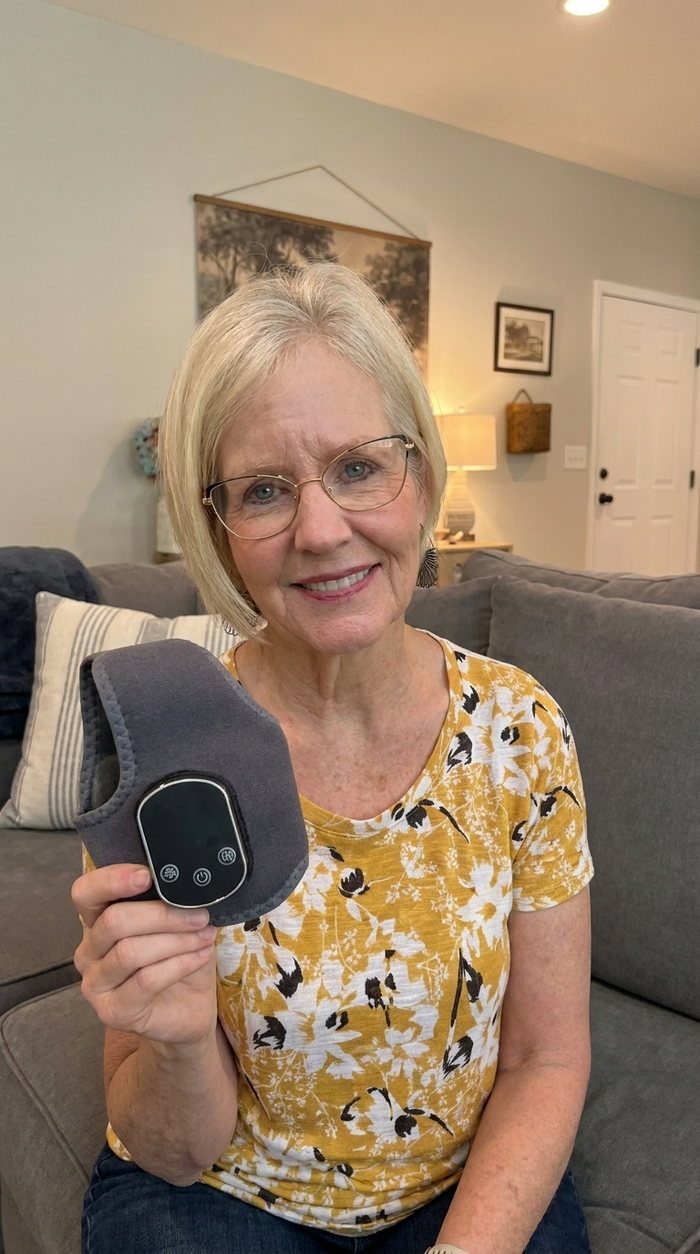
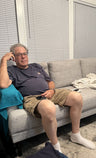
Thomas B. · Jacksonville, FL
"I've had plantar fasciitis for six years. My podiatrist kept saying manage it. This was the first week in months I didn't dread getting out of bed. Within a month, the morning heel pain was mostly quiet. I had no idea this kind of thing existed."
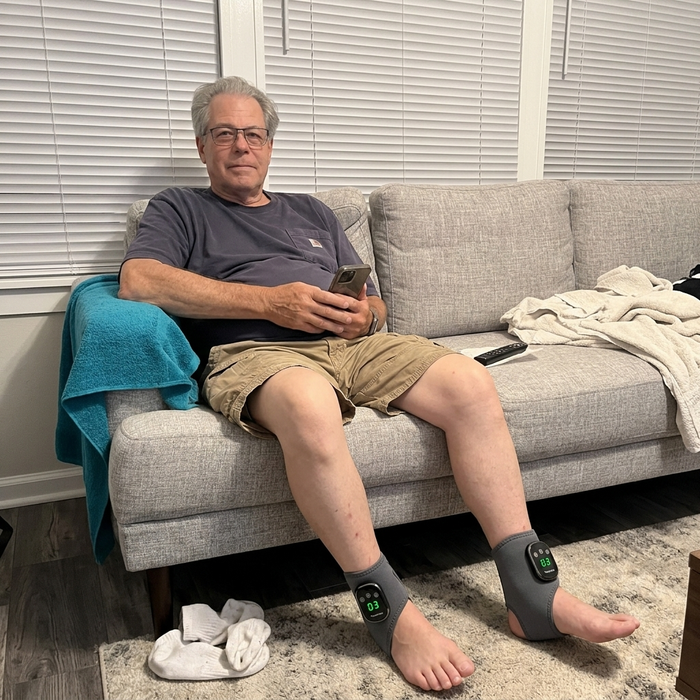

Linda R., 71 · Tampa, FL
"Three years of plantar fasciitis treatments that never lasted more than a few months. Two weeks with this device I walked two full laps around my neighborhood without stopping to let the heel settle. I told my daughter and she cried. That's how long it had been."
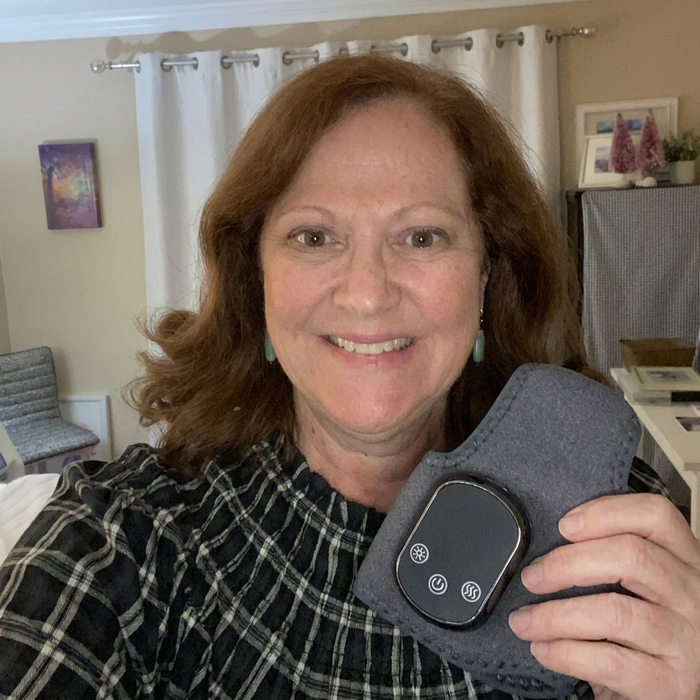

James W., 65 · Pensacola, FL
"Plantar fasciitis in both heels for seven years. My podiatrist said manage expectations. After six weeks with this I walked eighteen holes with my son for the first time in four years. Not just the morning pain — the afternoon ache that used to settle in by the back nine. That's changed too."
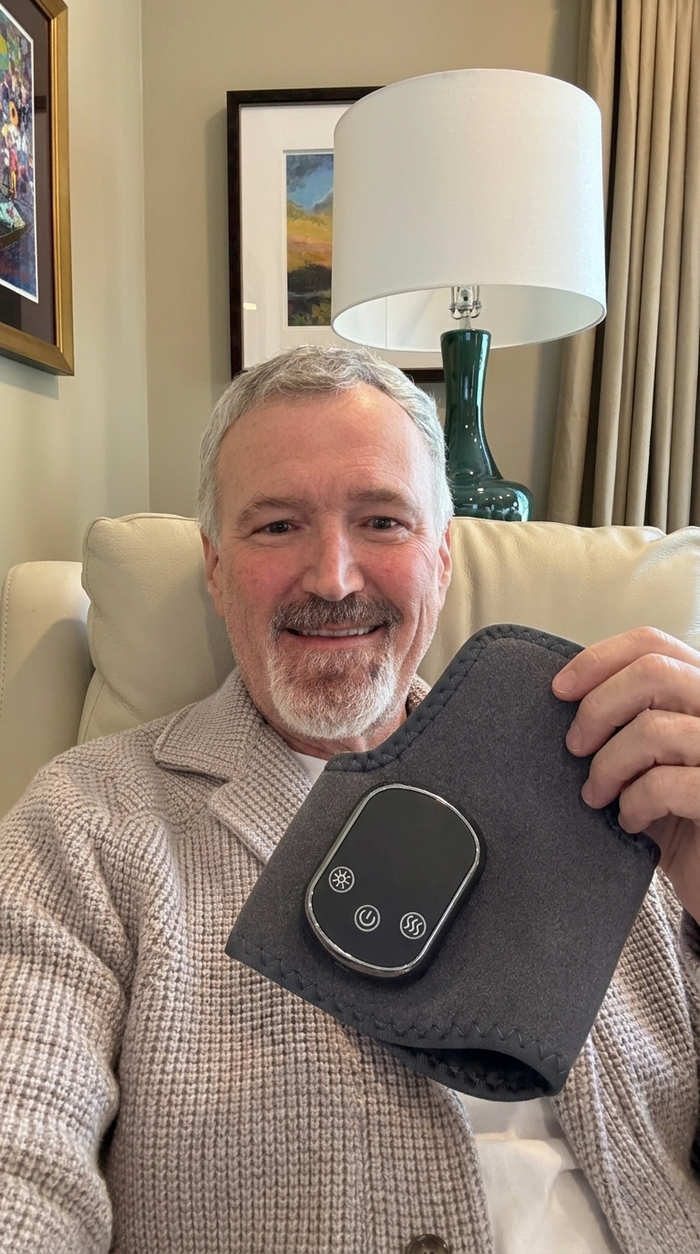

Margaret S., 67 · Atlanta, GA
"Bilateral plantar fasciitis. I'd tried everything already — orthotics, cortisone, foot rollers. None of it lasted. Week three of using this, my husband noticed I'd stopped gripping the mattress before I stood up. He said it was the first time in two years he'd seen me get out of bed without hesitating."
Free shipping · 60-day money-back
Is this the right device for you?
Morning heel pain checklist
- ✓ Your heel pain is worst in the first 5–10 minutes after waking or after sitting — that's the Achilles Lock. Exactly what this targets.
- ✓ Stretching your calves helps but the relief never lasts — means the Achilles chain is the problem, but stretching doesn't reach the attachment point.
- ✓ You've tried orthotics, injections, or foot rollers without lasting relief — they're all aimed at the foot. This sits at the joint.
- ✓ Physical therapy helped but you stopped (cost, time, access) — this is what PT was targeting. Every day, at home.
- ✗ Your heel pain is sharp during running or impact (not morning stiffness) — different issue — possible stress fracture or bone spur. See a physician.
Physical therapy gave me real progress — $1,200 in copays across fourteen weeks. When I stopped, the progress faded.
$59 devices treat the foot. $109 treats the Achilles — the actual source.
The Triple-Therapy Ankle Recovery System is $109.97 for a single wrap — one ankle, $70 off the regular price. That's about one PT session. And you can use it every day, not twice a week.
It works out to less than $0.31 a day for a full year.
What this costs — and what it's worth
Free shipping · 60-day money-back
The device, by the numbers
Common questions, honestly answered
How is this different from a foot massager or foot platform?
A foot platform sits under your sole and targets the surface of your foot. This wraps directly around the ankle joint — where the Achilles tendon inserts into the heel bone. The three therapies (heat, vibration, 660nm red light) are aimed at the Achilles attachment point, not the arch or sole. Different location, different target entirely.
How long until I notice anything?
Everyone is different. The first shift I noticed came in week one — the knife phase was shorter. By the end of the first month I was walking two laps around the neighborhood. Use it in twenty-minute sessions, once a day.
Is it safe to use at home?
It's USB-C rechargeable with automatic shut-off, and is CE, FCC and RoHS certified. As with any device, check with your doctor first if you have a specific medical condition.
What if it doesn't work for me?
It ships free and comes with a 60-day no-questions-asked refund. There's also a Symmetry Pair for both ankles at $149.97 — less than two PT sessions — because conditions that start on one side often show up on the other.
The decision is yours
We rebooked the National Parks trip. Tentatively. Spring.
I'm not promising canyon rims. But I'm not planning my exit route either.
We source in batches. The Solo Recovery wrap is showing limited availability at time of writing. If you're reading this, it's still available.
If your heel is waking you up every morning — and you're tired of treating your foot when the problem is above it — it's worth a look.
Reader Offer — Solo Recovery (1 Wrap)
Just $109.97 — save $70
About one PT session
- CE Certified
- FCC Certified
- RoHS Certified
- Free Shipping
- 60-Day Money-Back
Research References
The following sources support the mechanism claims in this article and are available for review.
- Achilles–plantar fascia mechanical chain — Systematic review (PRISMA), Foot & Ankle Surgery. Gastrocnemius contracture increases Achilles tendon tension, limiting ankle dorsiflexion and increasing strain on the plantar fascia at the calcaneal insertion. Arshad et al. 2022 · PMC8996295
- Posterior leg tightness in plantar fasciitis — NIH/NCBI clinical reference (StatPearls, updated Jan 2024). Tightness in the gastrocnemius, soleus, and posterior leg muscles is commonly associated with plantar fasciitis. · NBK431073
- Gastrocnemius contracture prevalence — Prospective case-control study, JBJS Vol 84, n=68. 65% of patients with foot pain conditions had isolated gastrocnemius contracture vs. 24% of healthy controls (p < 0.001). DiGiovanni et al. 2002 · PMID 12063330 (Note: sample is foot pain broadly, not PF-specific)
- Red light therapy for plantar fasciitis — Meta-analysis, 4 RCTs. Photobiomodulation therapy was found to be an effective treatment modality to reduce pain and improve foot function in patients with chronic plantar fasciitis. Almeida et al. 2019 · PMID 31107161