
Nerve Health
Your Nerves Aren't Dead. Nothing Has Reached Them.
A retired teacher tried gabapentin, heating pads, compression socks and B12 for three years. Then a physical therapist she'd met once explained where every one of them had stopped short.
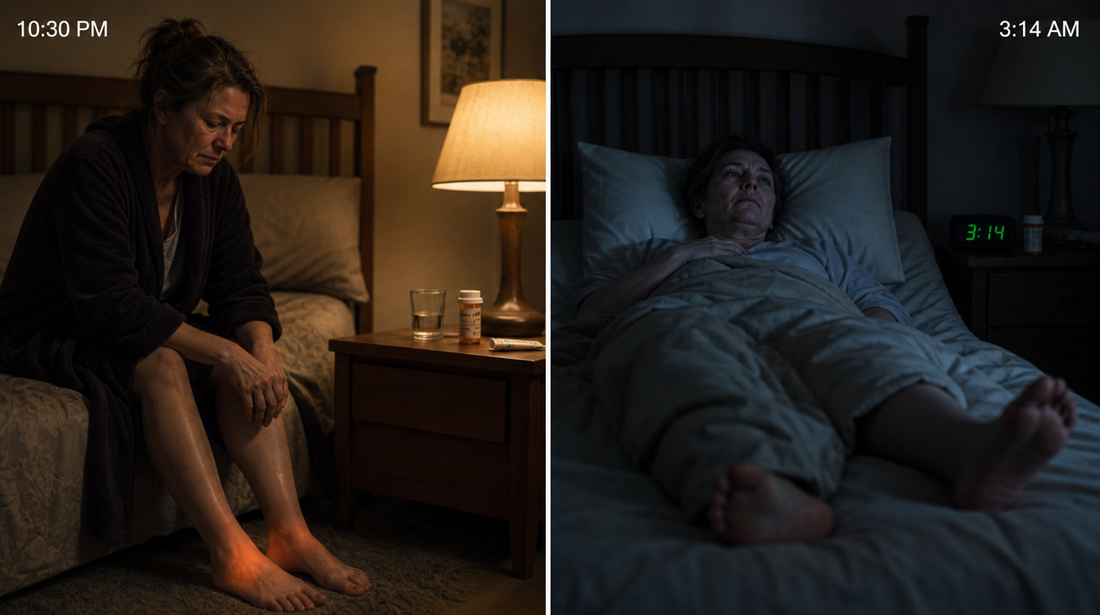
It's 3 in the morning, and I'm awake again. Not because of a sound. Not because of a dream. Because the burning has reached that level — the one that crosses from uncomfortable to impossible to ignore.
It starts in the balls of my feet and moves inward, toward the ankle. Tingling that somehow still hurts. Numbness that doesn't feel like nothing. If you know what I'm describing, you already know there's nothing to do except wait. Turn over. Try the other side. Eventually get up and sit in the kitchen with the lights off until it quiets down enough to sleep.
Free shipping · 60-day money-back
My name is Carol. I'm 63. I taught fourth grade in Sarasota for thirty-one years before I retired. Thirty-one years means thirty-one years on your feet — walking aisles between desks, standing at the board, supervising lunch, leading field trips in August heat. I understood tired feet. I thought I understood what my body was asking for. I didn't understand neuropathy.
Here's the part most people don't talk about: peripheral neuropathy is an invisible condition. From the outside, I look completely fine. I have good color. I walk with reasonable posture. When I show up to church or book club or my daughter's house for Sunday dinner, I look like a woman who is doing just fine.
My daughter thinks I'm exaggerating. My neighbor offered to pray for my "sore feet." My book club suggested I try better shoes.
You learn, after a while, to stop explaining. You learn to say "I'm a little tired today" when what you mean is "I was awake from 3 AM to 5 AM because my feet were burning and I couldn't find a position that helped."
The only place I didn't have to explain was a Facebook group for peripheral neuropathy patients. Two-point-eight million members who know exactly what burning feet at 3 AM feels like. In that group, you don't have to earn the right to be believed.
I stopped mentioning our Sunday walks to my husband. Richard and I had walked Celery Fields together every Sunday morning for eleven years — a nature preserve twenty minutes from our house, herons and egrets everywhere, beautiful light in the early hours. I'd stopped suggesting it quietly, about eight months in, when I realized the walks were leaving me in worse pain by afternoon. One Sunday he came home with photographs of an egret he'd seen at the waterline. He showed them to me without saying anything about why I hadn't come.
The neuropathy was diagnosed in my early sixties — first the tingling, then the burning, then the numbness that somehow managed to hurt. My neurologist said it was peripheral neuropathy. Common in people my age. We'd manage it.
You learn, after a while, to stop explaining. — Carol M.
The treatments that never reached the problem
I tried gabapentin for nearly two years. The first few months I thought it might be working. By the second year I understood what it was actually doing: dulling everything. Not just the burning — my concentration, my memory, the sharpness I'd spent thirty-one years keeping sharp. Two years of brain fog and weight gain for partial relief, and they told me that was a good outcome. I stopped taking it. My neurologist said that was my choice to make.
I tried a foot platform massager. Warm while I was using it. Back to the same burn within an hour. Compression socks helped with swelling that wasn't really my problem. Heating pad at night — surface warmth, no change in the 3 AM episodes. B12 supplements for five months, taken faithfully. Nothing I could measure.
None of it was dishonest. None of it was aimed at the right target.
Here's the thing about teaching reading for thirty-one years: you develop a very specific intolerance for misdiagnosed problems. When a child struggles to decode words, you don't just repeat the lesson louder. You find where the processing breaks down — phonemic awareness? Visual tracking? Working memory? The intervention only works when it's aimed at the actual fault, not the symptom showing up on the surface.
I had been applying treatments to the surface of my feet. The neuropathy was somewhere else entirely. I just didn't know where yet.
Free shipping · 60-day money-back
The discovery
One night close to midnight, I did something I'd never tried before. I couldn't sleep — the usual reason — and instead of scrolling through the neuropathy group, I posted. Just a few sentences: "Three years of peripheral neuropathy. The burning still wakes me at 3 AM. I've tried gabapentin, heating pads, compression socks, the supplements. Has anyone actually found something that worked?"
I wasn't expecting much.
Three hundred and twelve people replied in two days. I read through all of them. Same patterns everywhere — the sleeplessness, the treatments that almost worked and then didn't, the neurologists who ran out of ideas. After a while I stopped reading for answers and just read to not feel alone. That's what that group is for. Two-point-eight million people who understand without explanation.
No one had an answer that changed anything.
Then, on the third day, a private message arrived. A name I almost didn't recognize. We'd met at a professional conference years ago — he was a physical therapist from the panhandle, twenty-two years in practice. I hadn't heard from him since 2018. He had seen my post.
"Carol — I saw what you shared. Can I explain something your neurologist probably didn't have time to get into?"
I said yes. He sent several messages in a row. I read them slowly, sitting in the kitchen with the lights off, feet still burning.
Think about a plant at the far end of a long irrigation line, he wrote. The pump is working. The main pipe has plenty of flow. But by the time the water reaches the last emitter — a tube no wider than a thread — the pressure has dropped. The plant at the end of the line doesn't get enough. It doesn't die immediately. First it sends stress signals. Leaves wilt, turn strange colors, curl in ways they shouldn't. That's how a garden tells you it's thirsty — not by dying, but by misfiring first. Your ankle nerves work the same way.
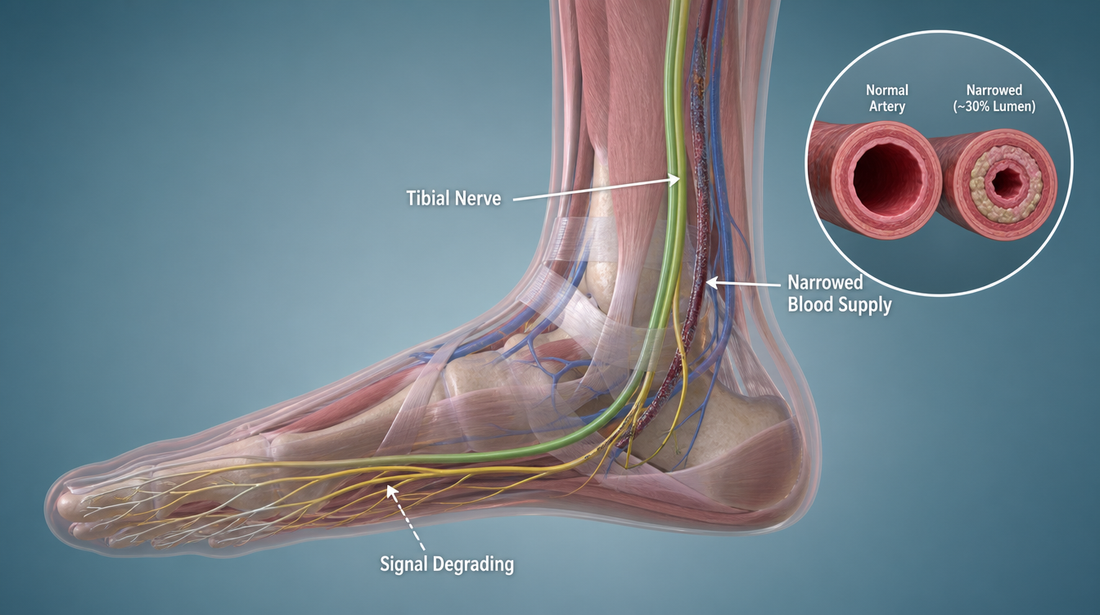
The nerve clusters in your lower leg — the tibial nerve and its branches — depend on tiny blood vessels to stay alive. Vessels thinner than a human hair. They carry oxygen and nutrients to nerve tissue that cannot function without a steady supply. As we age, those vessels narrow. Gradually. Without announcement. The same way an old irrigation line gets mineral buildup over the years — not broken, just reduced.
The nerve at the end of that line starts receiving less than it needs. And here's what most people don't realize: a nerve that's being starved doesn't go quiet. It misfires. It fires when nothing touched it. It burns when there's no heat source. It sends the signal for pain because signaling distress is exactly what a nerve does when its supply is running low. Like a plant that curls its leaves before it wilts — the nerve sends wrong signals before it loses feeling entirely.
You know that feeling — burning and numb at the same time, and you can't explain how both can be true at once? That's not confusion. That's two different kinds of nerve fibers failing at different speeds. The small fibers — the ones that carry heat and pain — degrade first. They misfire even as the larger fibers start to go quiet. So you feel burning. And you feel numb. At the same time. Because different parts of the same nerve are running on different levels of empty. That's not damage. That's a nerve that isn't being fed.
I sat with my phone for a long moment. He had just described thirty-one months of my life in four paragraphs. The 3 AM burning. The tingling that somehow still hurts. The numb that doesn't feel like nothing. I had told those things to my neurologist. I had typed them into that group post. I had never once had anyone explain back to me why.
Free shipping · 60-day money-back
The Nerve Depth Gap
Why every treatment stopped short
"Here's the problem with every treatment you tried," he wrote. "They were all aimed at the wrong address.
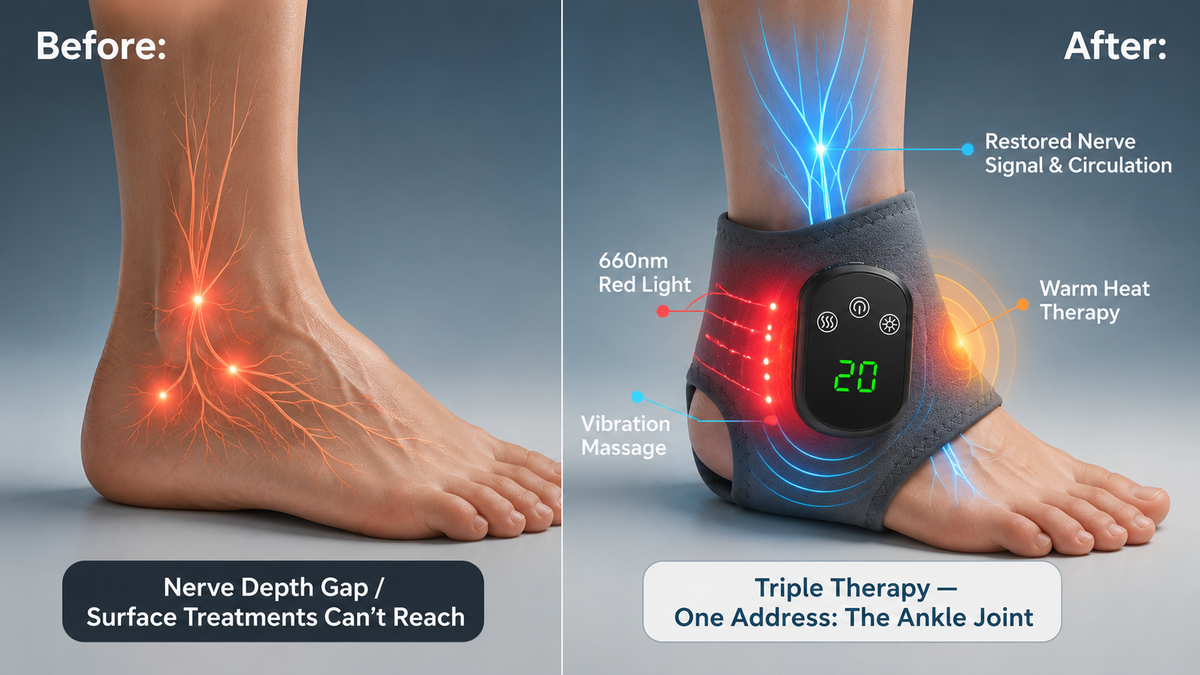
A heating pad on the bottom of your foot warms the skin. The nerve clusters at the ankle sit deep in the soft tissue layer — the warmth disperses long before it can reach there. Compression socks improve the circulation returning from your foot back toward the heart. Not the blood supply going in to feed the nerve tissue. Gabapentin works at the brain — it intercepts the pain signal before it registers as sensation, but it doesn't travel to the ankle, to the nerve itself, where the signal originates.
None of them reach deep enough. None of them address the starving.
Think of it as the Nerve Depth Gap. The distance between where a treatment is aimed and where the actual breakdown is. Every treatment you tried stopped before it reached the nerve — like water that can't make it to the end of the line."
I sat back with my phone and read that again. Think about what he was saying. You wouldn't stand at the far end of a dried-out irrigation line and fan air over the wilted leaves. You wouldn't tape the curling leaves flat and call the plant fixed. You wouldn't pour water on the soil three feet from the roots and call it watered.
You'd trace the line back. Find where the pressure dropped. Open the valve.
That's what every treatment I'd tried had done instead. Gabapentin numbed the signal at the brain — the leaves. The heating pad aimed at the bottom of my foot — the leaves. Compression socks addressed circulation flowing back toward my heart, not the blood supply flowing in to feed the nerve tissue — the leaves. B12 supplements circulated through everything except the specific supply line that had narrowed. Every one of them had responded to what the plant was showing on the surface. None of them had found the valve. None of them had asked where the flow was cut off.
So the nerve kept sending the signal. Because the nerve was still starving. You cannot fix a supply problem by treating what the shortage produces.
I typed back: I've been a reading teacher for thirty-one years. We call that a misdiagnosed problem. The intervention only works when it's aimed at the actual fault.
He replied: Exactly. And here's what actually reaches it.
Free shipping · 60-day money-back
Three therapies, one place — the ankle joint
He mentioned a device he'd been watching patients use at home — something that had come out of clinical photobiomodulation research. Something that actually addressed the right depth. I looked it up.
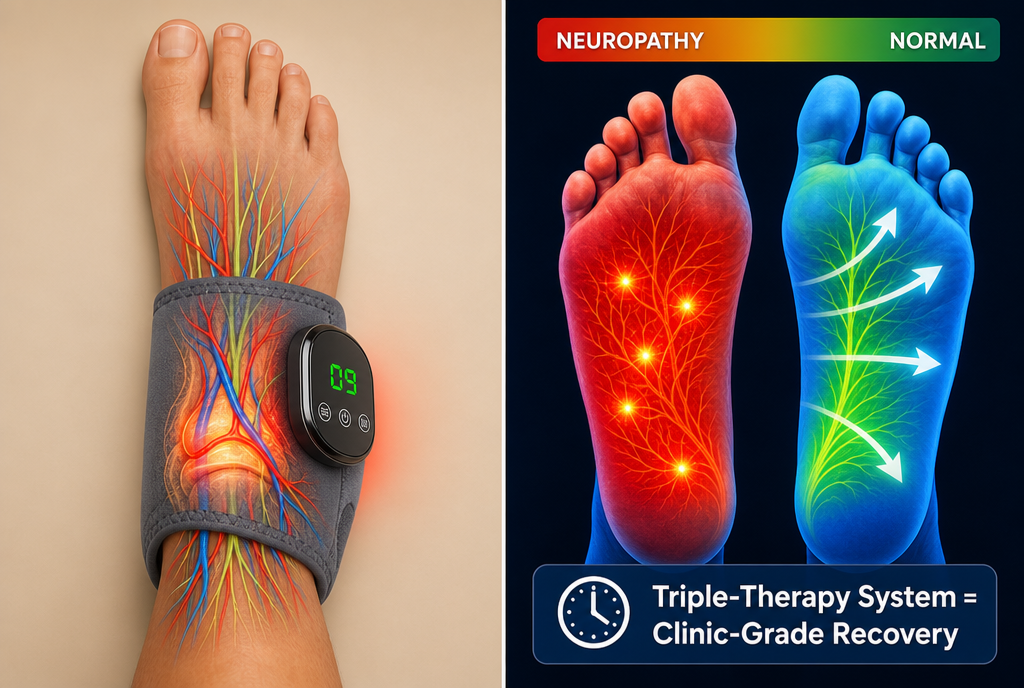
It's called the Triple-Therapy Ankle Recovery System. It doesn't sit under your foot. It wraps 360 degrees around the ankle joint — directly on the tissue where the nerve clusters actually are.
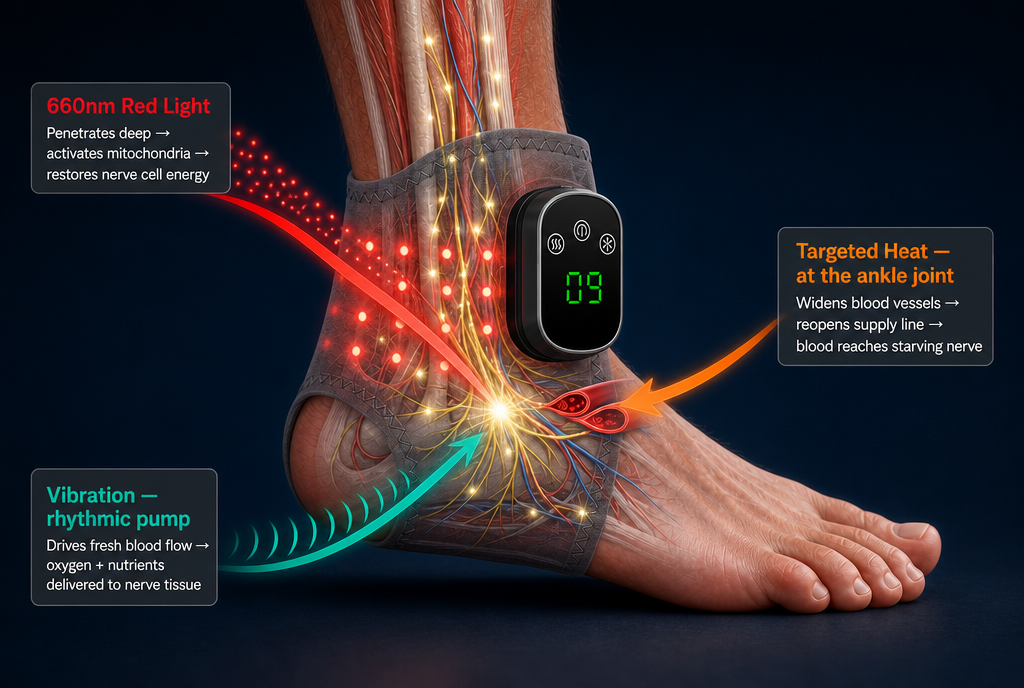
Think back to what he described: a plant at the far end of an irrigation line — a nerve that isn't receiving enough blood supply. What would it take to fix that? You'd need to open the supply line. You'd need to push more flow through. And if the nerve had been starving long enough, you'd want to reach it directly — not wait for the pipes to catch up. That's exactly what the three modalities do.
660nm Red Light
A wavelength studied for its ability to penetrate soft tissue — deep enough to reach where the nerve clusters and blood vessels sit in the ankle. Unlike heat, which disperses at the surface, 660nm photons travel through skin to reach deeper structures. Once there, they act like a direct power source for the nerve cells themselves — activating the cellular machinery responsible for producing energy, so nerves that have been running on empty can finally begin to repair.
Targeted Heat
Applied at the ankle joint itself, at 5 precise levels from 40°C to 60°C, with intelligent auto-shutoff. This isn't the same as a heating pad on the bottom of your foot. Heat applied directly at the ankle widens the blood vessels that feed the nerve tissue — reopening the supply line the nerves have been waiting on. The five precise levels matter because neuropathy patients can't always feel when heat goes too high. The auto-shutoff isn't a minor feature. For neuropathy patients, it's a real safety question.
Vibration
Works like a pump. The rhythmic movement pushes fresh blood through the ankle joint — carrying oxygen and nutrients directly to the nerve tissue that has been starved of both. Open the supply line. Push more flow through. Reach the nerve directly.
Twenty-minute sessions. The same window physical therapists use.
I ordered it.
Free shipping · 60-day money-back
Here's exactly what happens in those 20 minutes
The Triple-Therapy Ankle Recovery System isn't a platform under your foot. It's a 360° wrap — full contact around the entire ankle joint from all sides. That matters because the nerve clusters, the blood vessels that feed them, and the tibial nerve branches don't all sit in one place. They run around the joint. A device that contacts only one surface misses most of the target anatomy.
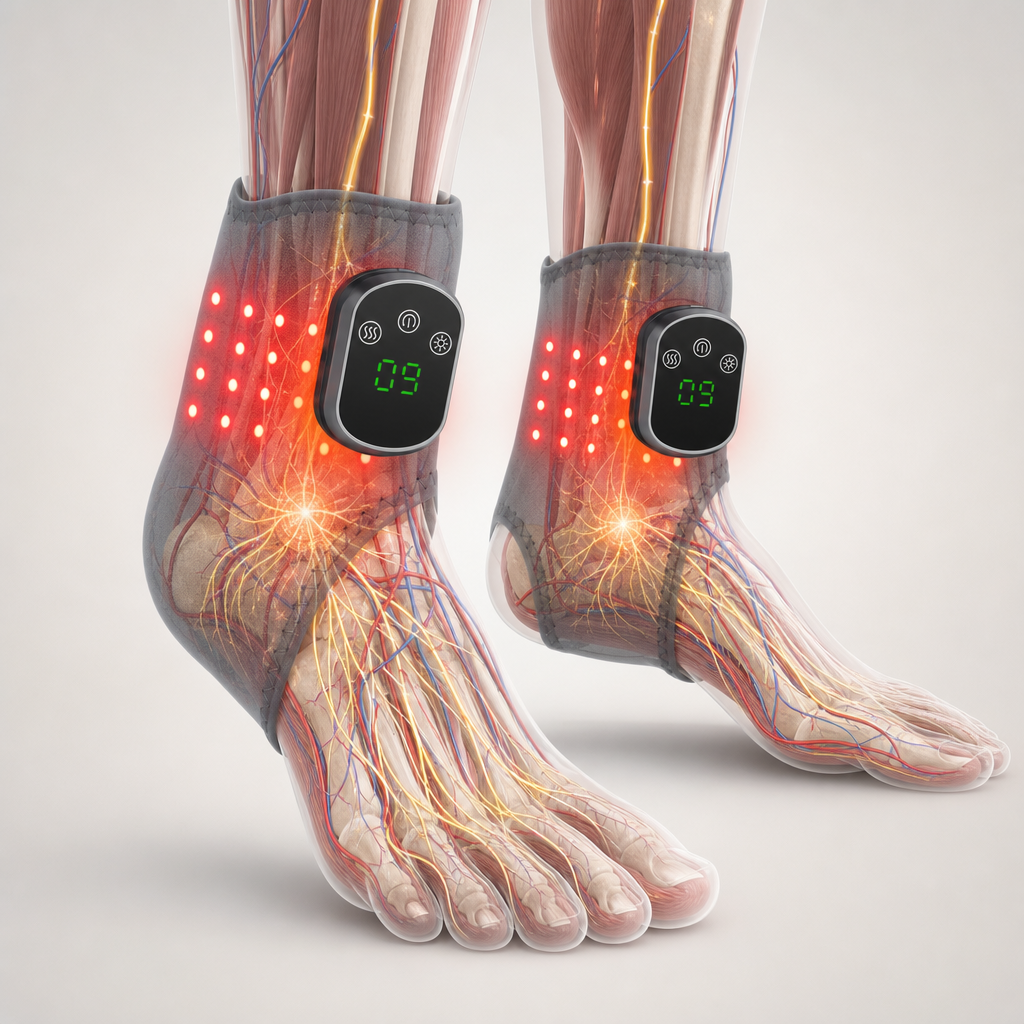
The 660nm red light. The wrap contains 40 three-core LED beads emitting at 660nm. This wavelength was chosen because 660nm photons don't stop at the skin surface the way standard heat does — they travel through skin and soft tissue, deep enough to reach the layer where the nerve clusters and their blood supply actually sit. Once there, they interact with the mitochondria inside nerve cells — the part of the cell responsible for producing ATP, the fuel every cell runs on. Nerve cells that have been running on low energy because their supply line was narrowed start receiving what they need to function. The distress signal changes — not because it was masked, but because the cells producing it are finally being supplied.
The heat — at the right address. Five precise levels: 40°C, 45°C, 50°C, 55°C, 60°C. Not vague "high / medium / low" — degree-specific, controllable. Applied directly at the ankle joint, where the blood vessels feeding the nerve tissue have been narrowing. Heat at that location causes those vessels to widen. The supply line that has been narrowing for years — the same line that's been starving the nerve — starts to reopen. Blood flow increases to tissue that has been waiting for it. Because neuropathy affects how much you can feel, intelligent auto-shutoff activates if temperature drifts outside safe range. For someone who can't always sense when heat is too high, that isn't a minor feature — it's the reason this device can be used safely where a standard heating pad cannot.
The vibration — the pump. Three vibration modes, delivered through the ankle joint. Rhythmic mechanical movement pushing fresh blood through the joint — oxygen and nutrients moving into the nerve tissue that has been starved of both. The heat opens the supply line. The vibration keeps blood actively moving through it.
All three working simultaneously. The 660nm reaching the nerve cells directly. The heat reopening the vessels that feed them. The vibration driving fresh blood through. The same nerve that's been sending burning signals at 3 AM — the same nerve that's been running on a depleted supply for months or years — is now receiving what it needs from three directions at once.
Twenty minutes. Then you remove it and continue your day.
What's in the box
- 660nm red light, targeted heat and vibration in one wrap
- USB-C rechargeable — cordless while you use it
- Automatic shut-off
- CE, FCC and RoHS certified
- Twenty-minute daily sessions — the same window physical therapists use
Free shipping · 60-day money-back
What changed, week by week
First session, I sat with my Kindle and set a timer. Skeptical enough to have low expectations. Twenty minutes. No dramatic sensation.
Week one: I woke at 3 AM the way I always did. But when I lay there waiting for the burn to peak — it didn't. It reached a certain level and held there. The first time in longer than I could remember that the 3 AM window passed without me moving to the kitchen.
Week two: the nighttime episodes were shorter. The morning numbness lifted faster. I walked to the end of the block and back without dreading the afternoon. By the end of the first month, I said to Richard: "Do you want to walk Celery Fields on Sunday?" He didn't say anything. He went and got his jacket. We walked two miles. I saw an egret standing still in the shallows — the same spot he'd photographed, maybe. I didn't say anything about what the walk meant. He already knew.

For years, I was treating the surface. The nerves were below it. — Carol M.
Free shipping · 60-day money-back
Real people, real relief

Dorothy K., 68 · Richmond, VA
"I've had bilateral neuropathy for four years. I was skeptical of everything at this point. By week three, I slept through the night for the first time in two years. I ordered a second one for my sister in Dallas."
Thomas B. · Jacksonville, FL
"My wife has had diabetic neuropathy for six years. She said this was the first week in months she didn't dread going to bed. Within a month, the nighttime burning was mostly quiet. I'm ordering one for myself now — I had no idea this kind of thing existed."
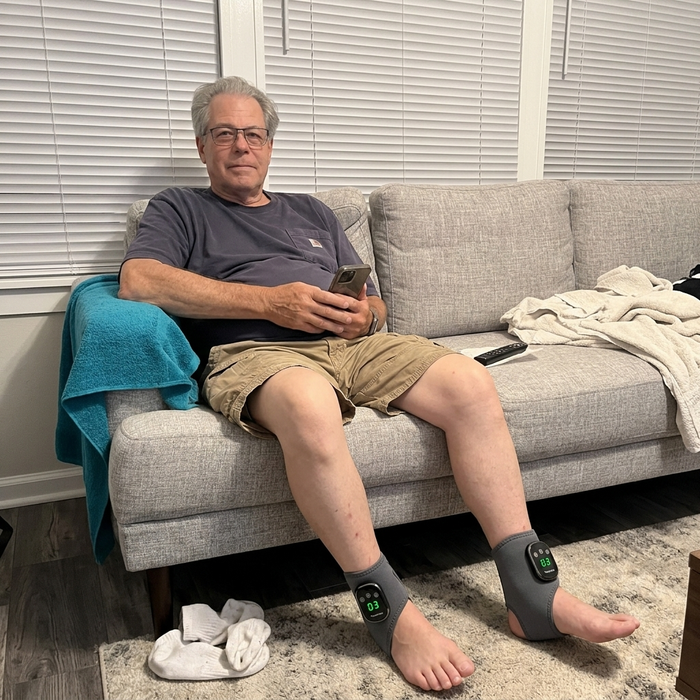

Linda R., 71 · Tampa, FL
"Chemo ended three years ago but the neuropathy stayed. My oncologist said it was expected. I called it three years of burning feet every night with nothing to show for it. Two weeks in with this device I slept through to 5 AM. I told my daughter and she cried. That's how long it had been."
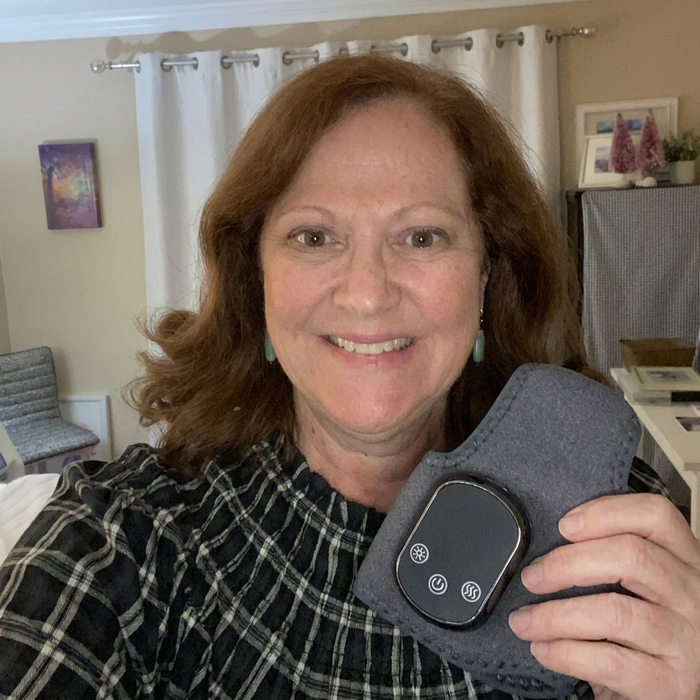

James W., 65 · Pensacola, FL
"Diabetic neuropathy in both feet for seven years. My doctor said manage expectations. After six weeks with this I walked eighteen holes with my son for the first time in four years. Not just the burning — the numbness had scared me most. That's changed too."
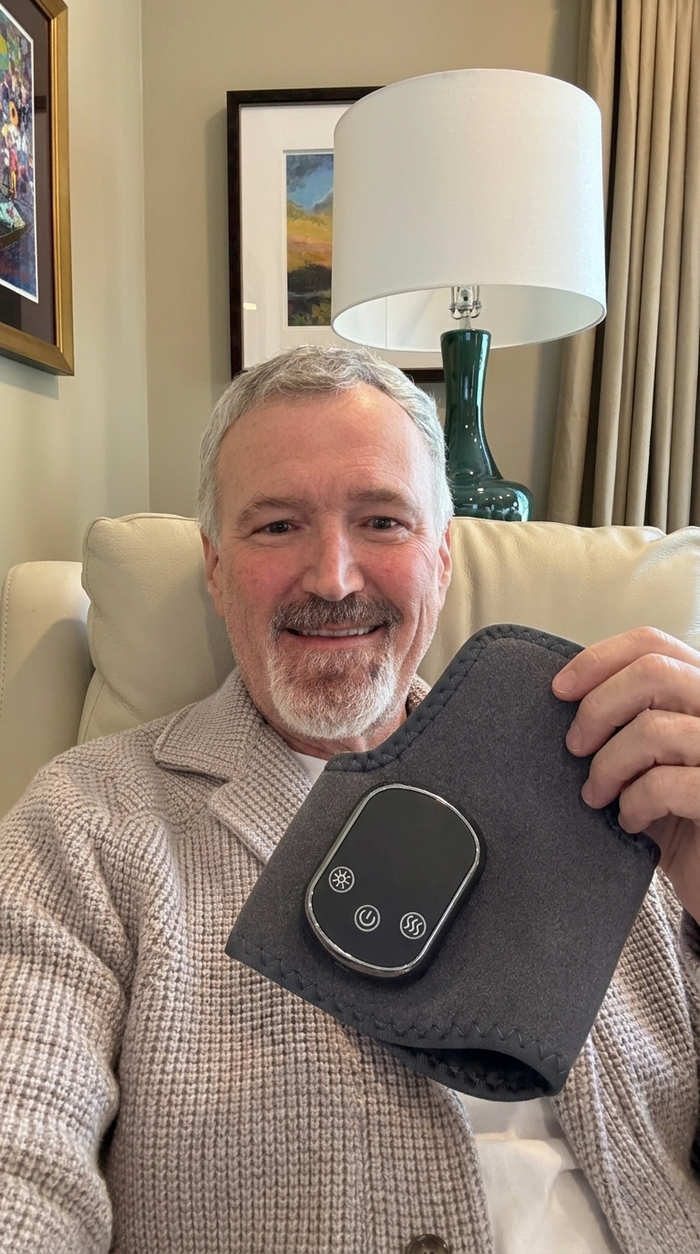

Margaret S., 67 · Atlanta, GA
"Bilateral neuropathy. I'd tried everything already — gabapentin, B12, foot massagers. None of it reached far enough. Week three of using this, my husband noticed I stopped getting up at 3 AM to sit in the dark. He said it was the first time in two years he'd woken up and I was still there."
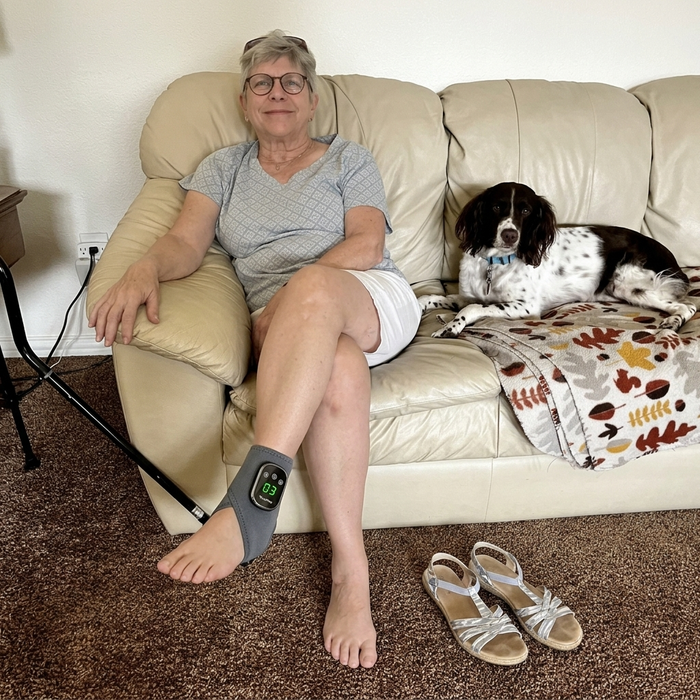
Free shipping · 60-day money-back
What about the alternatives?
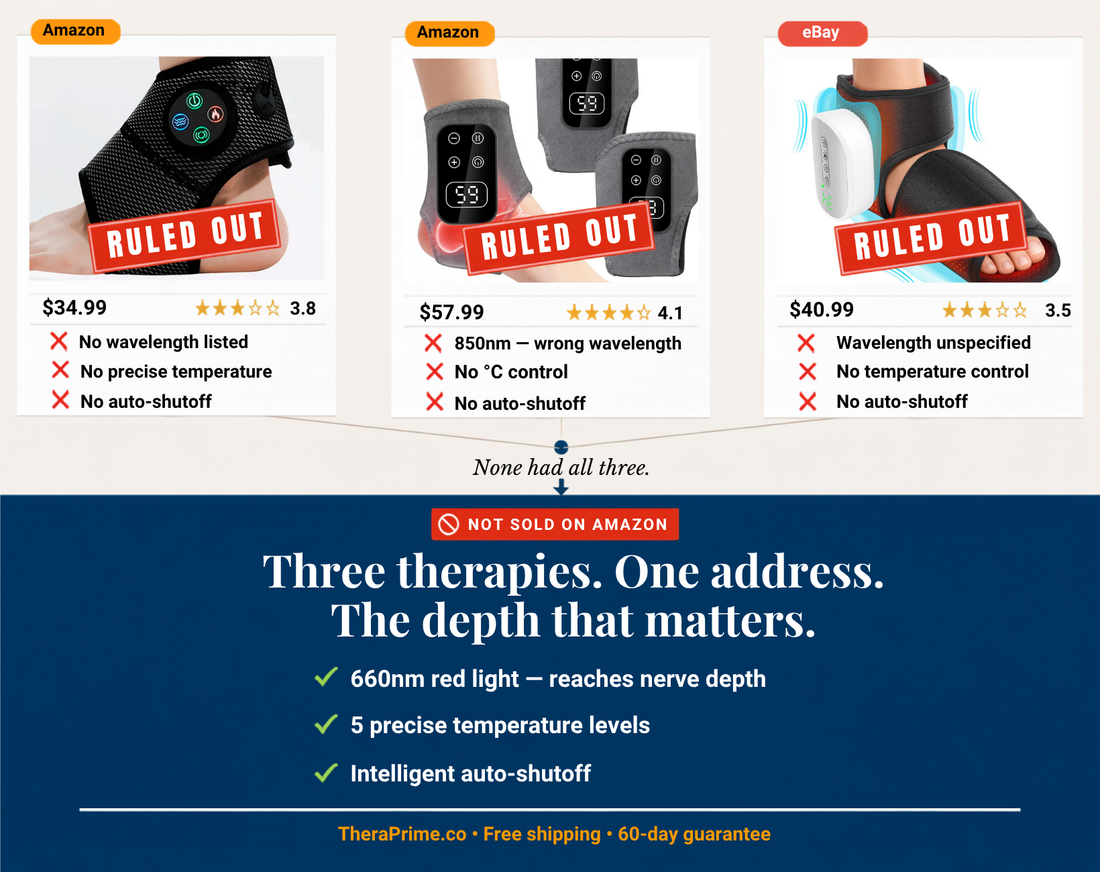
Before I paid anything, I did what I always do before a significant purchase: I searched for alternatives. There are products on Amazon and various websites that look almost identical in the thumbnail — an ankle wrap, LED lights, some form of heat or vibration. Some have decent reviews. Several cost $30 to $60. Here is what I found when I looked more carefully.
Most of them do not have 660nm. They have LED lights — often described as "red light therapy" — but at wavelengths that don't interact with tissue the same way. 850nm is a different wavelength with different penetration characteristics. "Infrared" without specification often means something else entirely. 660nm specifically is the wavelength where the research on nerve tissue function exists — where the interaction with mitochondria in nerve cells has been documented.
Here's why that matters. The 660nm photons reach the nerve cells and interact with cytochrome c oxidase inside the mitochondria — the enzyme that drives ATP synthesis. ATP is the fuel every cell runs on. Nerve cells running on a depleted supply — because their blood line narrowed — are essentially energy-deficient. When the 660nm reaches those cells directly, it provides the mitochondria with what they need to increase ATP production. Cells that were signaling distress begin to stabilize — not because the signal was blocked, but because the energy deficit is finally being addressed at the source.
A device without 660nm has removed the direct line to the nerve cells. You're left depending entirely on heat and vibration to improve circulation — and improved circulation genuinely helps. But it assumes blood supply improvement alone is sufficient. For nerve tissue that has been starved long enough, that assumption may not hold.
Think of it this way. You can widen the irrigation hose. You can add a pump. But if a plant has been starving long enough, improving the water supply alone may not revive it. Sometimes the plant needs something delivered directly — not through the supply line, but applied at the root level. That's the 660nm. It doesn't wait for the irrigation system. It reaches the cells directly, activates the energy machinery inside them, and the cells that were signaling distress begin to stabilize because they are finally being fueled.
This isn't three separate features packaged together. It's three therapies designed to address the same underlying problem from three distinct angles simultaneously: open the supply line, drive blood through it, and reach the nerve cells directly with the energy they need to function. Remove any one of them, and you've addressed two of three angles. The third remains untouched.
Before you compare listings: check the wavelength — the number matters, not just the label "red light therapy." Check whether all three modalities are actually present and specifiable, not just listed. Check whether the heat has precise temperature levels and an auto-shutoff, not just "warm / hot." If you can't find that information clearly stated in the product description, assume the answer is no.
Here's what this level of therapy costs anywhere else.
What this costs — and what it's worth
Free shipping · 60-day money-back
Three therapies. One 360° wrap. Twenty minutes a day. Here's the full picture — by the numbers.
The device, by the numbers
Common questions, honestly answered
How is this different from a heating pad?
A heating pad warms the skin surface. This wraps the ankle joint and adds 660nm red light, which is studied for its ability to penetrate deep into soft tissue — reaching the layer where the nerve clusters sit. It's working at a different place, not just a different temperature.
How long until I notice anything?
Everyone is different. The first shift I noticed came in week one, and the nighttime episodes got shorter over the following weeks. Use it in twenty-minute sessions, once a day.
Is it safe to use at home?
It's USB-C rechargeable with automatic shut-off, and is CE, FCC and RoHS certified. The heat has intelligent auto-shutoff — designed specifically for patients who can't reliably feel when heat goes too high. As with any device, check with your doctor first if you have a specific medical condition.
What if it doesn't work for me?
It ships free and comes with a 60-day money-back guarantee — a complete refund, no questions asked. For bilateral neuropathy there's also a Symmetry Pair for both ankles at $149.97 — less than two clinic sessions of photobiomodulation therapy.
Is it safe if I have diabetes or take blood thinners?
Many users with Type 2 diabetes use this device — diabetic neuropathy is exactly the condition it was designed for. The intelligent auto-shutoff is especially important here, because reduced sensation means you may not detect when heat goes too high. If you take anticoagulants or have open wounds or active infection at the treatment site, check with your doctor first. As always, consult your healthcare provider before starting any new therapeutic regimen.
The decision is yours
I still wake up sometimes at 3 AM. But less often. And when I do, there's less fire. After thirty-one years of teaching children to find where the breakdown was — finally knowing that the breakdown is being addressed at the right depth is what I'd call real progress.
The current batch was manufactured in limited quantity. Raw material costs for the next run are increasing. We cannot guarantee this price — or stock availability — after the current inventory sells through.
If you're reading this, it's still available.
If your feet are burning at night and the people in your life can't see it — this was designed for exactly the right place.
Reader Offer — Solo Recovery (1 Wrap)
Just $109.97
About one clinic session
- CE Certified
- FCC Certified
- RoHS Certified
- Free Shipping
- 60-Day Money-Back
Research References
The following sources support the mechanism claims in this advertorial. References are provided for transparency and are available for review at the links below.
- Tibial nerve depth at the ankle — Ultrasound study, 100 healthy volunteers. Mean depth at retromalleolar level: 9.1mm (range 4.6–13.9mm). PMC12732173
- Tibial nerve anatomy — tarsal tunnel bifurcation — Cadaveric study. 88% of cases: bifurcation occurs within the tarsal tunnel. PMC3718430
- Circulation and nerve function — Animal study (STZ diabetic rat model). Vascular dysfunction in arterioles supplying the sciatic nerve region was detectable before measurable slowing of nerve conduction velocity — supporting the role of blood supply in nerve signal quality. PMC2477757
- Photobiomodulation therapy for peripheral neuropathy — RCT, n=200, Type 2 diabetic peripheral neuropathy. PBMT (10 sessions) significantly reduced neuropathic symptoms and improved protective foot sensation vs. control. PMID 40090424